Check out the latest USDA publication using AutoNorm for full-length 16S sequencing
READ NOW


NGS Library Prep · Data Quality
In NGS library prep, every normalization method balances read counts after PCR — after the damage is already done. AutoNorm protects your sequencing data quality during amplification, so you stop losing the reads that matter.
.png)
The problem
For years, "normalization" has meant one thing: balancing read counts so your sequencer runs evenly. Bead-based, enzymatic, CRISPR, manual — they all do it the same way. After PCR.
But by the time you're balancing reads, PCR has already decided your data quality. Over-amplified samples are carrying duplicates and chimeras. Under-amplified samples have already dropped out. Balancing the pool doesn't undo any of it — it just makes the problem invisible.
So your raw read counts look great. Your usable data, after quality filtering, tells a very different story.
"If we over-amplify, we compromise our data. If we under-amplify, we have dropouts. PCR is the biggest bottleneck." Pranav Patel, CEO, n6
The proof
Raw read counts look nearly identical. Then you filter for quality — and post-amplification normalization can't hide it anymore.
.png)
We followed every read from our own 16S soil study through processing — trimming, then DADA2 — comparing fixed-cycle PCR vs AutoNorm on the exact same samples.
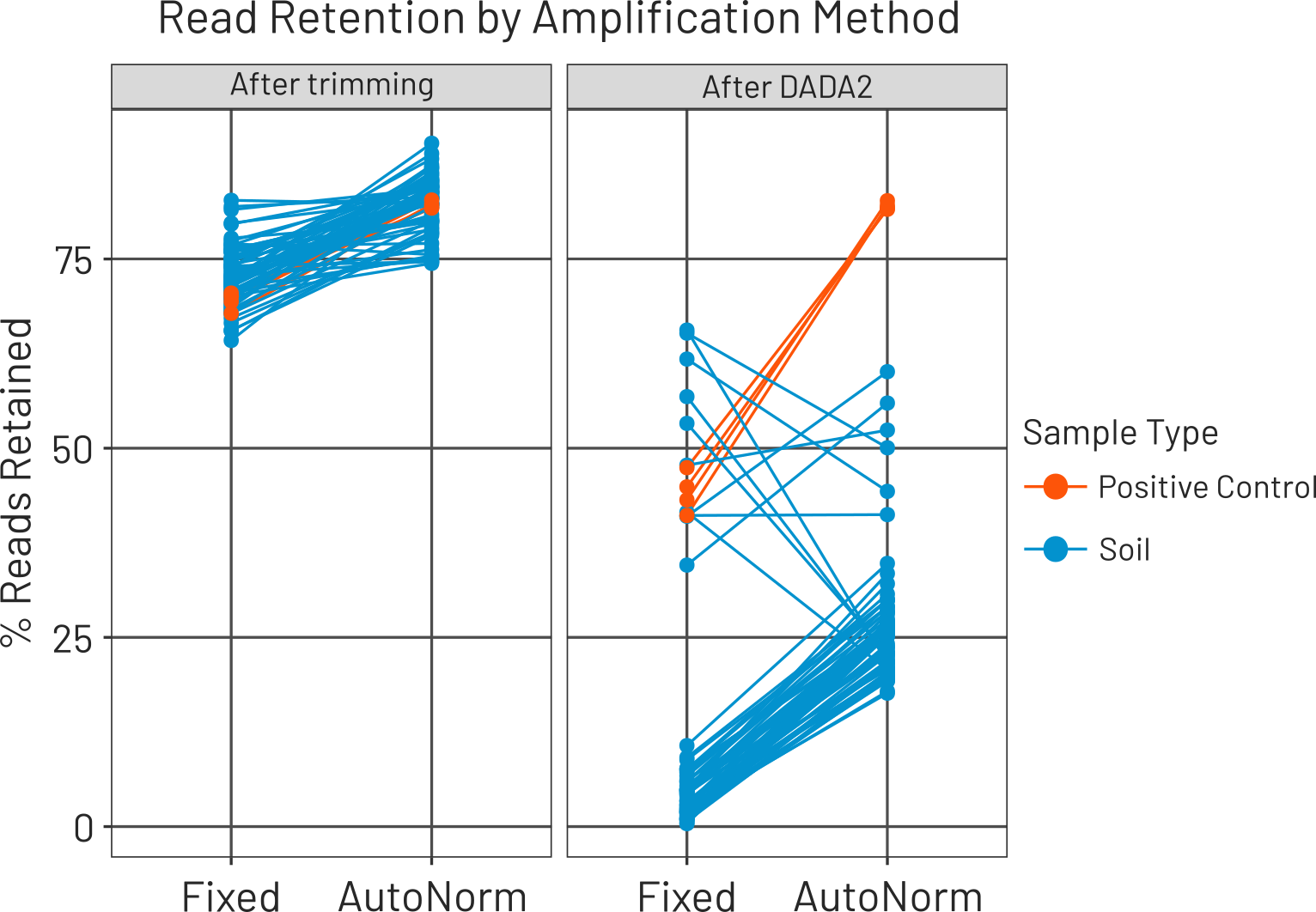
58 / 64
samples improved (91%) — more reads retained through processing.
Jouvenot et al., bioRxiv 2024 (preprint)Even
read distribution across wildly heterogeneous sample inputs.
Multiple independent labsHow it works
AutoNorm runs on iconPCR™ — the world's first thermocycler with individually controlled wells. Instead of guessing a cycle number and hoping, iconPCR watches each reaction in real time and stops every well at exactly the right point. No over-amplification. No under-amplification. No dropouts.
The result isn't just a balanced pool. It's balanced reads plus optimal amplification for every single sample — which is what real normalization was always supposed to mean.

STEP 01
Amplify with real-time monitoring
Every well watched individually as it runs.
STEP 02
AutoNorm stops each well at its ideal endpoint
No sample over- or under-amplified.
STEP 03
Pool and sequence
Directly combine libraries with more usable reads.
Works with your existing assays, reagents, and sequencers. No proprietary kits.
.png)
Every read you generate should be a read you can use. That's the standard we built iconPCR around: give every well exactly the amplification it needs, and protect data quality sample by sample — instead of balancing read counts after the damage is done.
Because in NGS, quality isn't something you recover in analysis. It's something you protect at library prep.
Independent evidence
"
Autonormalized libraries generally retained a high proportion of sequences following denoising and chimera removal, exhibited low residual error rates (<0.005%), and yielded relatively even read distributions.
Mason et al., ASM mSphere
Peer-reviewed, 2026
"
If anything, it actually improves the data quality.
Anja Mezger
SciLifeLab / National Genomics Infrastructure
"
AutoNormalized reactions consistently retained a higher proportion of sequences, exhibited fewer substitution-based errors, and produced more even read distributions.
PacBio
on n6 + full-length 16S
Trusted across sequencing cores, research institutions, service & solution providers.









Applications
Clinical inputs
FFPE & degraded samples
Reduced dropouts and PCR duplicates on the hardest clinical inputs.
View the poster →Microbial ecology
Microbiome & 16S
Higher biological resolution; detects taxa other methods miss.
View the poster →Scale
High-throughput cores
Even representation across hundreds of heterogeneous samples, blind-pooled.
View the poster →Respect the read
See Autonorm protect what your current workflow quietly loses.
Loading form…


