Check out the latest USDA publication using AutoNorm for full-length 16S sequencing
READ NOW



Whole Genome and Whole Exome Sequencing Libraries, Balanced by Adaptive Amplification Instead of Fixed Cycles
Whole genome and whole exome workflows live and die by amplification consistency — one over-cycled well and your coverage uniformity, variant calls, and cost-per-genome all take the hit. iconPCR™ with AutoNorm monitors every well in real time and stops each reaction the moment it hits its optimal endpoint, so FFPE DNA, low-pass ag genomes, and ultra-high-throughput production sequencing all come off the plate already balanced — no fixed-cycle guessing, no manual normalization, no dropout roulette.
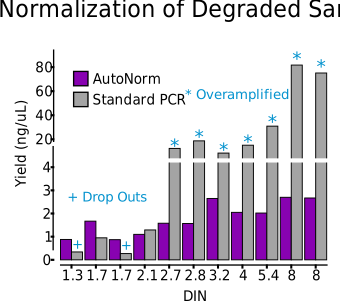
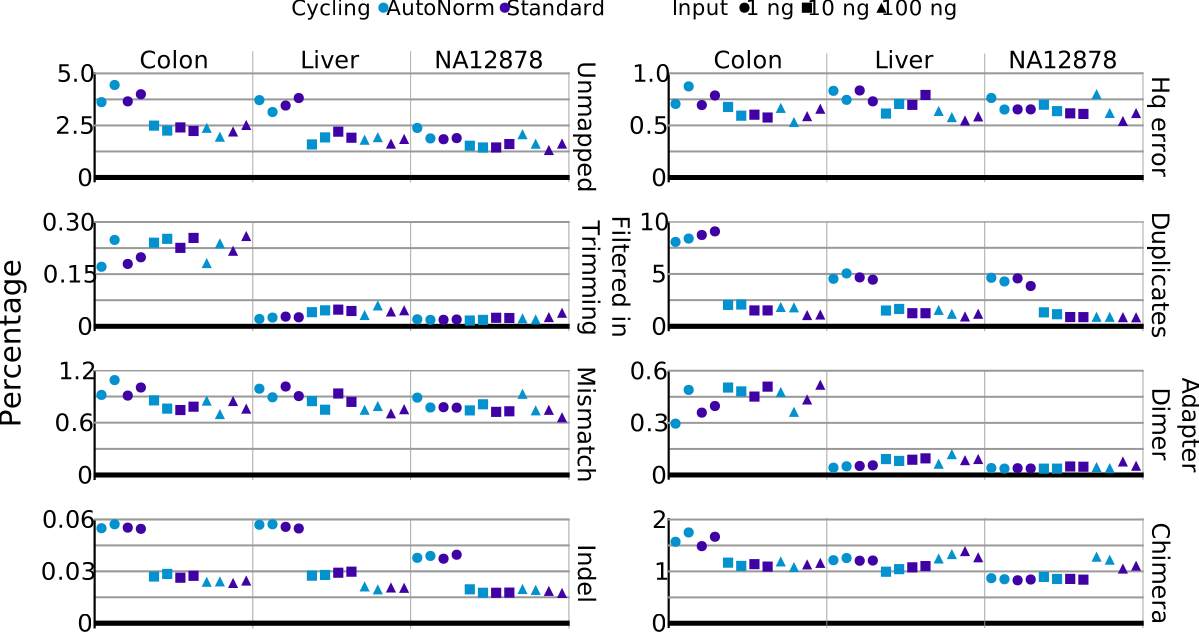
FFPE-derived DNA breaks the usual relationship between input mass and amplifiable template, which is exactly the scenario fixed-cycle PCR handles worst. In this n6/NEB study, FFPE colon and liver DNA plus a high-quality NA12878 control were prepared at 1, 10, and 100 ng using the NEBNext UltraShear FFPE DNA Library Prep Kit and NEBNext Multiplex Oligos for Illumina, then amplified with either standard fixed-cycle PCR or iconPCR with AutoNorm. Standard PCR required three separate thermocycler runs (14, 12, and 8 cycles by input level); iconPCR ran every sample simultaneously on a single icon96, with AutoNorm dynamically assigning each well its own stop cycle — accounting for the reality that even samples at the same input mass need different cycle counts depending on degradation. The result: markedly reduced concentration variability across libraries and comparable data-quality metrics (duplication, adapter dimer, chimera, mismatch rates) to standard PCR, with far less hands-on time and no batch segregation required.
Chen Song, PhD (NGS Applications and Product Development, New England Biolabs) and Yann Jouvenot, PhD (n6) walk through how pairing iconPCR's real-time AutoNorm technology with NEBNext library prep kits tackles the input variability and degradation that make FFPE samples so unpredictable to amplify. The session covers real application data showing roughly 70% less variance in final library concentrations compared to traditional fixed-cycle methods, how a single AutoNorm run handles inputs from 1 ng to 250 ng without batching, and practical tips for integrating NEBNext kits directly into an iconPCR workflow — plus how per-well control prevents the overamplification artifacts (adapter dimers, PCR duplicates, expression-profile shifts) that quietly erode data quality in degraded samples.
Watch the Webinar
Built on the same production-scale story as n6's Ultima Genomics collaboration, this app note shows how AutoNorm's real-time, per-well control eliminates the post-PCR quantification and normalization steps that become the real cost bottleneck once sequencing itself gets cheap. Instead of fixed-cycle amplification followed by individual SPRI cleanup, quantification, and manual pooling for every sample, AutoNorm continuously tracks fluorescence in each well and stops amplification once it reaches an empirically defined optimal endpoint — so high-input samples finish early and low-input samples keep cycling until they catch up, and the whole plate comes off already balanced. The approach cuts hands-on time by up to 60%, minimizes failed libraries, and maintains balanced read distribution for whole genome sequencing, all without extra reagents or a liquid-handling robot.
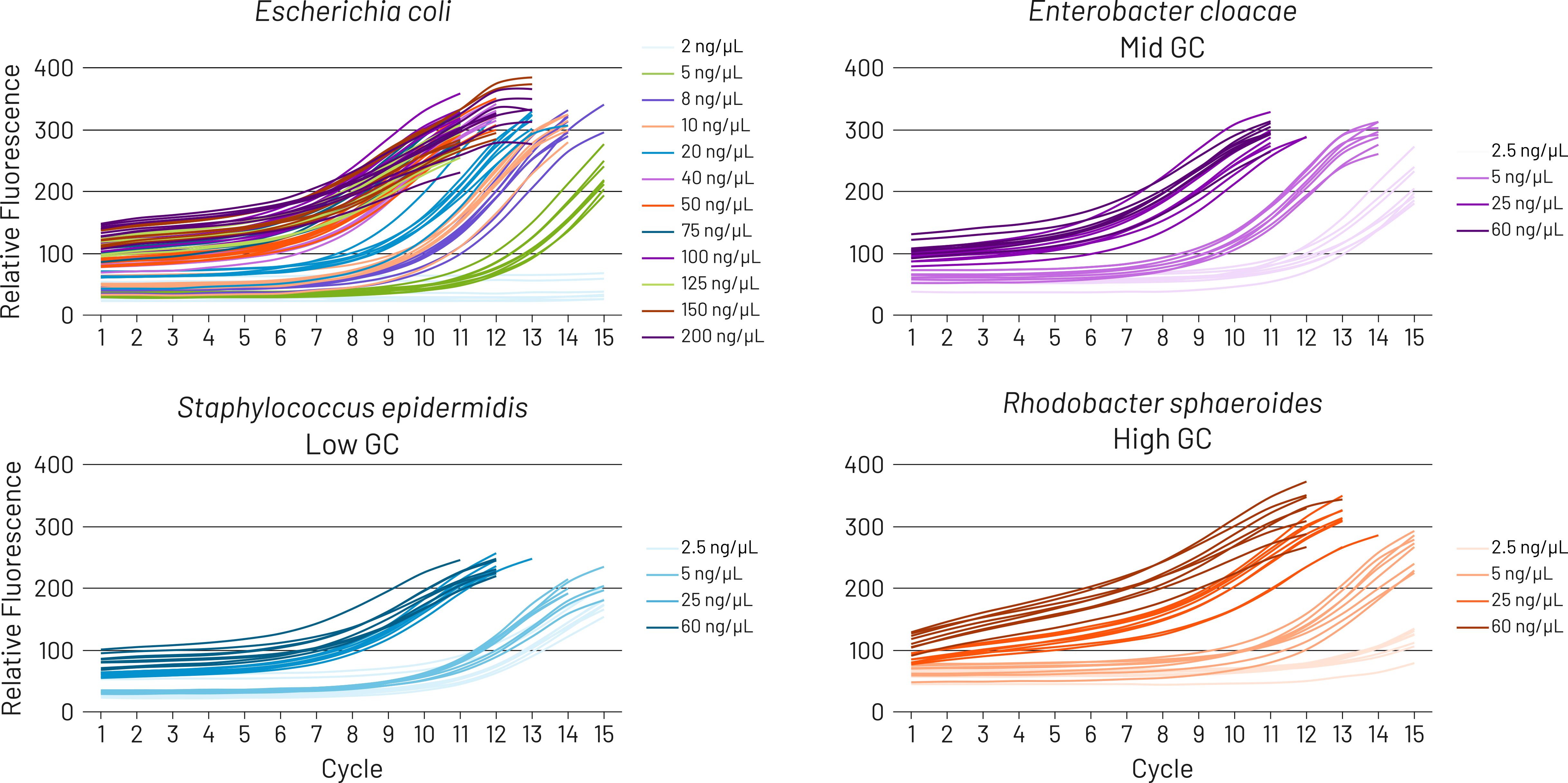
Microbial whole genome sequencing brings its own amplification headaches — wide swings in GC content and a 100-fold range of usable input mass, in this case demonstrated across E. coli and a multi-microbe panel spanning a 24-fold GC-content range. Pairing seqWell's ExpressPlex library prep with iconPCR's AutoNorm lets a single run absorb that variability automatically: each well amplifies to its own optimal endpoint regardless of starting GC content or input amount, instead of forcing every microbial genome in the plate through the same fixed cycle count.
These three posters carry the WGS/WES story to the conference floor — production-scale sequencing economics, low-pass agricultural genomics, and FFPE-to-WGS library normalization with Covaris.
A 10–120 ng dilution series of Genome in a Bottle DNA (HG006/NA24694) run through 96-plex droplet-emulsion PCR showed AutoNorm cutting library-prep time, tips, tubes, and plates by more than 95% versus standard processing — while keeping multiplexed sample representation uniform.
View the PosterIn low-pass WGS for agricultural genomics, where library prep — not sequencing — is the real cost driver, AutoNorm removed over 66% of manual library-prep steps while keeping pooled libraries balanced despite wide swings in genome size and species.
View the PosterCovaris and n6 paired the truCOVER DNA Library Prep and Amplification kits with iconPCR across HG001 control cells and six distinct FFPE tissue samples, confirming that AutoNorm normalization holds up end-to-end from FFPE extraction through NextSeq 2000 sequencing.
View the Poster


