Check out the latest USDA publication using AutoNorm for full-length 16S sequencing
READ NOW



Full-Length 16S and Metagenomic Sequencing, Without the PCR Guesswork
Metagenomic and 16S samples never arrive equal. Fecal, soil, skin, and insect-gut specimens can vary in microbial biomass by orders of magnitude in the same batch, so a single fixed PCR cycle number is always wrong for someone in the plate. iconPCR™ with AutoNorm monitors fluorescence in every well in real time and stops each reaction at its own optimal endpoint — reducing chimera formation by up to 4x and revealing more unique amplicon sequence variants, including the rare and elusive ones fixed-cycle PCR amplifies away. Explore the webinars, publications, and posters below to see what full-length, autonormalized 16S sequencing uncovers.
A high-mass fecal sample and a dilute wastewater DNA extract can sit in the same plate, alongside specimens with a low bacterial-to-host mass ratio and residual inhibitor carryover from extraction. One fixed cycle number cannot serve all of them. Some wells over-amplify and generate chimeras and false positives. Others under-amplify and drop real taxa, producing false negatives that read as biological absence. iconPCR with AutoNorm ends each reaction at its own endpoint, so cycle number becomes a per-sample result instead of a plate-wide assumption.
Standard short-read 16S microbiome sequencing can make a community look complete when it isn't: fixed-cycle PCR introduces artifacts, and short hypervariable regions leave entire taxonomic groups undetected. In this webinar, Jeremy Wilkinson (PacBio), Dr. Charles Mason (USDA ARS), and Dr. Mary Arrastia (n6) show how full-length 16S sequencing paired with per-well adaptive amplification changes what's discoverable in complex microbial communities. Real data from insect gut microbiomes and agricultural soils shows autonormalized library preparation more than doubling unique ASV detection on PacBio — jumping from 24% to 59% of reads mapping to unique ASVs — while delivering balanced read counts across sample inputs spanning orders of magnitude in concentration.
Watch the Webinar
Advancing Long-Read 16S rRNA Metagenomics: Workflow Innovations for Robust Results
Library prep consistency and amplification bias are two different problems that both have to be solved for reliable microbiome sequencing. Yann Jouvenot (n6) and Ethan Thai (Zymo Research) walk through how combining the ZymoBIOMICS full-length 16S library prep workflow with iconPCR's per-well adaptive amplification reduces chimera rates and improves read normalization compared to fixed-cycle PCR, streamlining full-length 16S rRNA library prep for diverse sample types and making results more reproducible lab to lab.
Watch the Webinar
Whether you're running short-region or full-length 16S, per-well real-time control changes what shows up in your community profile. This application note details how iconPCR with AutoNorm reduces chimeras by up to 4x and reveals more unique amplicon sequence variants than fixed-cycle PCR, delivering balanced, deeply resolved libraries with hands-off pooling regardless of input amount or sample source — so your data reflects the real diversity in every tube, not PCR-driven noise.

Metagenomic samples are some of the hardest inputs in NGS: high-mass fecal samples, dilute wastewater DNA, low bacterial-to-host DNA ratios, and carried-over inhibitors all push fixed-cycle PCR toward over- or under-amplification, producing chimeras and false positives/negatives. Presented at AGBT Ag 2025 by AgriGro, Element Biosciences, and n6, this poster compares standard and iconPCR-autonormalized workflows across two studies: a soil metagenomics comparison across PacBio, Illumina, Element, and LoopSeq platforms, and a "kitchen sink" 16S profiling run spanning fecal, soil, skin, vaginal, and buccal samples. On PacBio, AutoNormalization raised unique ASV detection from 24.1% to 59.0% of reads. In the kitchen sink run, inputs varying 800-fold (0.2 ng to 163 ng, 154% coefficient of variation) still produced final read counts within a 15% coefficient of variation across all 14 samples.
View the Poster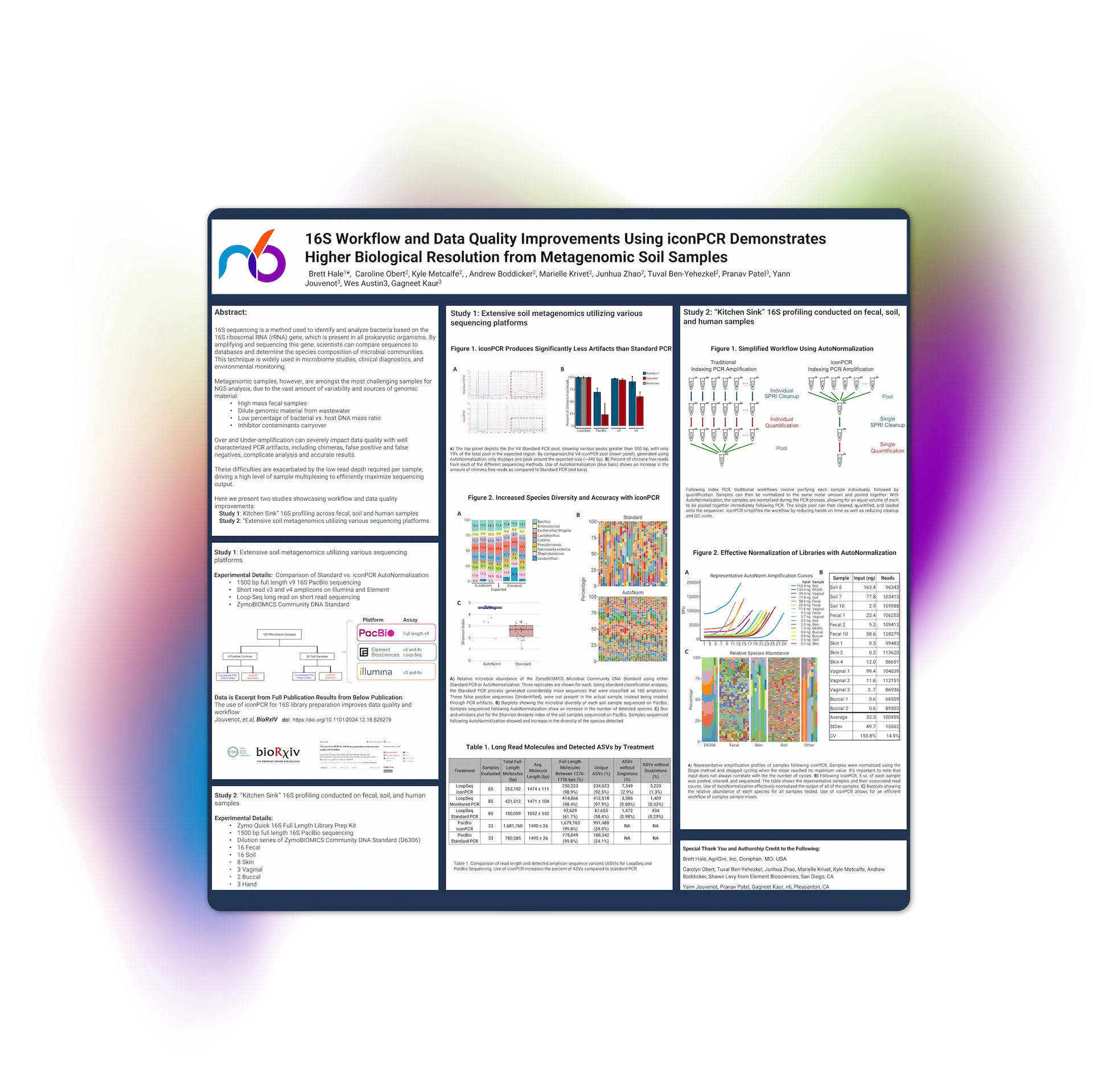
Mason, Weaver, Kissinger, Johnson, Copeland, Anderson, and Geib (USDA ARS) evaluated PCR cycle autonormalization for PacBio Kinnex full-length 16S rRNA sequencing across seven agriculturally relevant specimen types, comparing fixed 20-, 24-, and 30-cycle protocols against iconPCR autonormalization. Autonormalized libraries retained the largest number of processed reads after quality control (10.5M reads, versus 8.3M at 30 cycles), held residual error rates under 0.005%, and produced a comparatively tight, even distribution of final read counts across heterogeneous specimens. The 30-cycle protocol, by contrast, showed elevated error rates and greater sequence loss during denoising and chimera removal, especially in the most biodiverse samples — while PCR protocol had only a minor effect on overall community composition compared with specimen type itself.Mason et al., 2026, mSphere
Read the Publication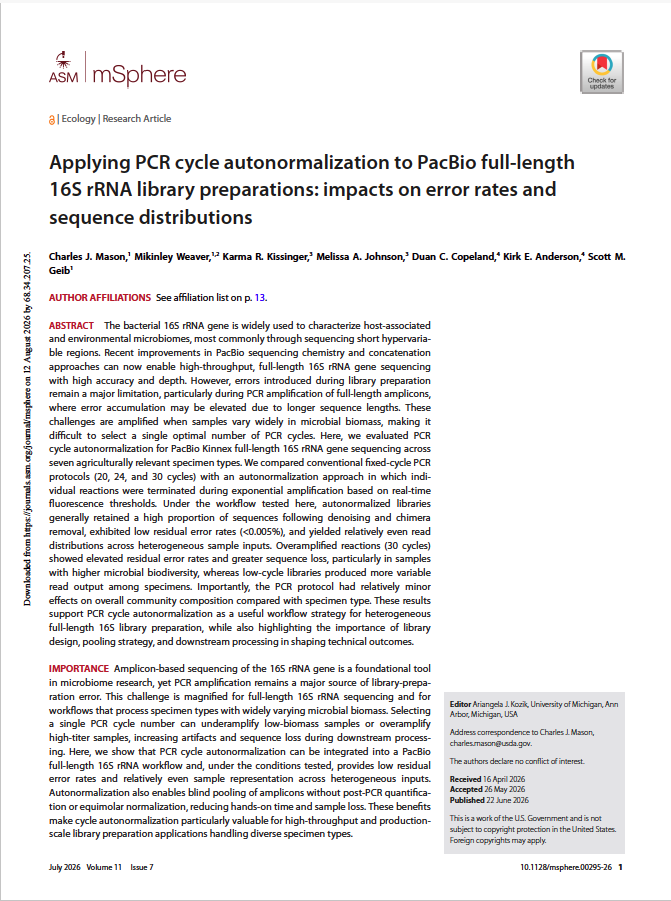
Jouvenot et al. (2024, bioRxiv) applied iconPCR to generate V3, V4, and full-length 16S rRNA gene libraries using Avidite sequencing, then evaluated the V1–V9 full-length libraries with HiFi sequencing — demonstrating improved microbial community analysis accuracy and reliability across chemistries.
Read the PreprintGeib et al. (2026, bioRxiv) used full-length 16S rRNA sequencing on a Kinnex library, sequenced on PacBio Revio, to reveal substantial bacterial composition differences across medfly cohorts that V4-only sequencing missed entirely — with strain-level variation confirmed by shotgun metagenomic genome assembly.
Read the PreprintGreen et al. (2026, bioRxiv) evaluated carrier DNA spike-in for shotgun metagenome sequencing of ultra-low (under 50 pg) metagenomic DNA inputs, paired with iconPCR's adaptive cycling to allow dynamic thermocycling regardless of detectable input. Libraries were prepared down to 50 femtograms of input, with adaptive cycling — not carrier DNA — doing the heavy lifting for samples below standard detection limits.
Read the Preprint


