Check out the latest USDA publication using AutoNorm for full-length 16S sequencing
READ NOW


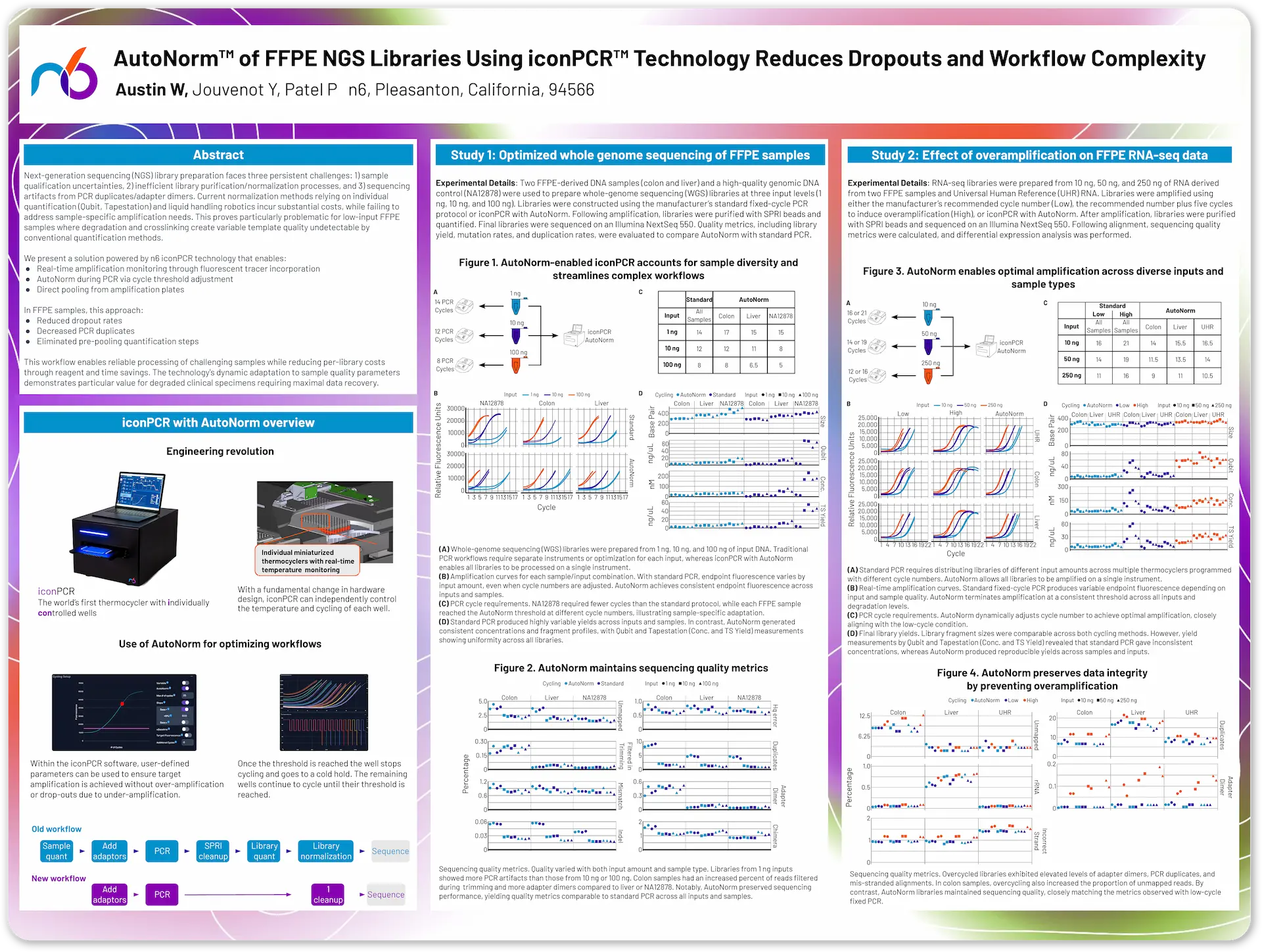
Next-generation sequencing (NGS) library preparation faces three persistent challenges: 1) sample qualification uncertainties, 2) inefficient library purification/normalization processes, and 3) sequencing artifacts from PCR duplicates/adapter dimers. Current normalization methods relying on individual quantification (Qubit, Tapestation) and liquid handling robotics incur substantial costs, while failing to address sample-specific amplification needs. This proves particularly problematic for low-input FFPE samples where degradation and crosslinking create variable template quality undetectable by conventional quantification methods.
We present a solution powered by n6 iconPCR technology that enables:
In FFPE samples, this approach:
This workflow enables reliable processing of challenging samples while reducing per-library costs through reagent and time savings. The technology's dynamic adaptation to sample quality parameters demonstrates particular value for degraded clinical specimens requiring maximal data recovery.