Real-time, per-well amplification for variable RNA inputs
iconPCR technology with AutoNorm monitors amplification in each well and stops cycling at a defined endpoint, building normalization into PCR rather than relying on a fixed cycle count. Explore application data and resources for bulk RNA-seq, FFPE RNA, small RNA, and single-cell library preparation.
Final library concentration CV, standard PCR compared with AutoNorm, across three tissue types at 1 ng and 10 ng inputs.
Thermocycler runs across cDNA amplification and index PCR in the single-cell study, 500 to 10,000 cell inputs.
Lower cost to generate RNA-seq data, as reported by HudsonAlpha for its apple and pear biomarker projects.
Each figure is the result of one specific published study under its own conditions, linked in the matching section below. They are not combined performance claims, and they are not guarantees for another laboratory, chemistry, or sample type.
AutoNorm controls amplification of the cDNA or DNA library generated during an RNA-seq workflow, using real-time fluorescence to determine when each well stops cycling. Independent well control lets samples reach the selected amplification endpoint at different cycle numbers, rather than requiring one fixed cycle count for the entire batch.
Apply AutoNorm within a validated library-preparation workflow; retain the cleanup and sequencing QC steps required by that workflow.
See how AutoNorm works →01 / Bulk RNA-seq
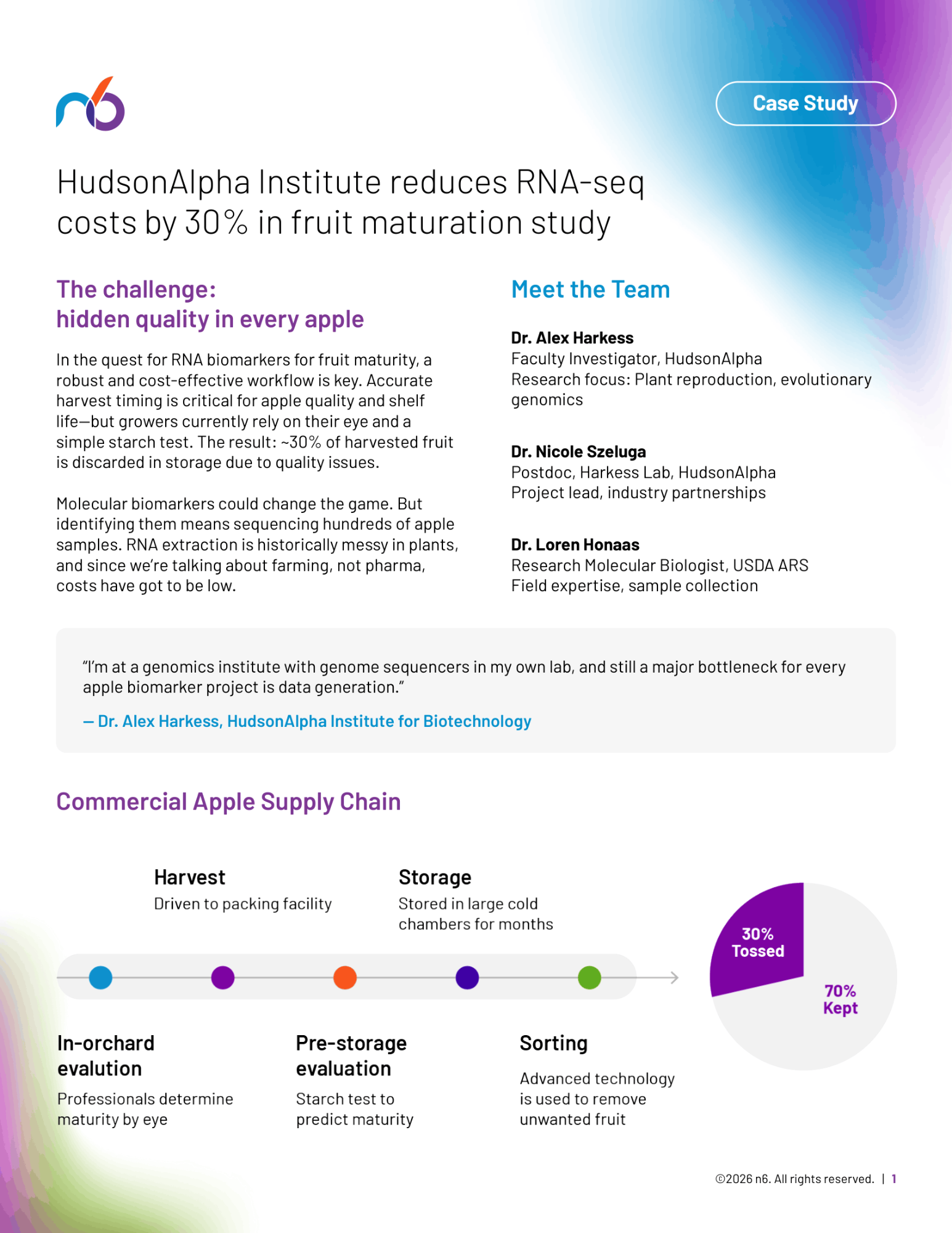
Customer case study · HudsonAlpha InstituteA scalable workflow for RNA-based biomarker discovery
HudsonAlpha researchers used icon96 with AutoNorm in an apple-maturation project involving 384 apple-peel samples, addressing variable RNA inputs and labor-intensive normalization. The case study reports fivefold input variation and 11 of 14 RNA biomarkers consistently associated with harvest timing, connecting an adaptable library-preparation workflow to a practical research application. HudsonAlpha reported approximately 30% lower costs to generate RNA-seq data for its apple and pear biomarker projects.
Dr. Aziz Al’Khafaji, an n6 scientific advisor, discusses methods development and data generation across single-cell and bulk applications, including 150 postmortem brain samples.
02 / FFPE RNA-seq
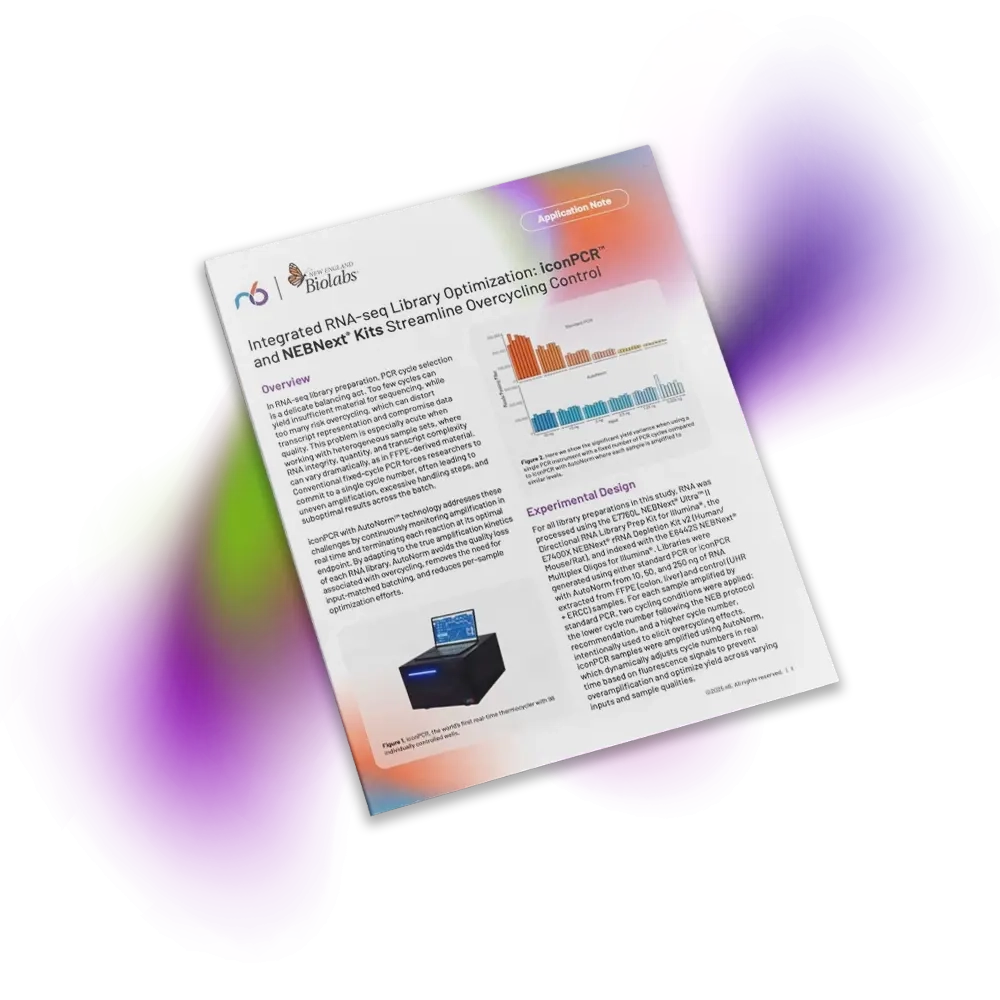
Application note · NEBNext RNA library preparationAdapt amplification to variable input quantity and integrity
In an FFPE RNA-seq cycle-titration study, increasing amplification from 14 to 24 cycles reduced aligned-read percentages and detected gene counts while increasing PCR duplicates; the experiment used 50 ng RNA from one FFPE sample. A separate comparison evaluated AutoNorm across four FFPE RNA samples at 1, 10, and 100 ng, allowing mixed inputs to be amplified together with sample-specific cycle control.
Integrated RNA-seq Library Optimization: iconPCR and NEBNext Kits Streamline Overcycling Control
The webinar is a broader FFPE session, not an RNA-only validation study.
03 / Small RNA-seq
Application note · with RevvityMore consistent library concentrations across different tissue inputs
An icon96 study using NEXTFLEX Small RNA-Seq Kit v4 compared standard PCR with AutoNorm for human brain, skeletal-muscle, and placenta RNA at 1 ng and 10 ng inputs. Final library concentration CV decreased from 48.5% to 25.6%, with no significant differences reported in RNA-class distribution between the tested workflows.
AutoNorm of NEXTFLEX small RNA libraries using the iconPCR system
| Final library concentration CV | Standard PCR | AutoNorm |
|---|---|---|
| Three tissue types; 1 ng and 10 ng inputs | 48.5% |
25.6% |
04 / Single-cell RNA-seq
Related application · single-cell transcriptomicsIn a study using 10x Genomics GEM-X Universal 3′ Gene Expression v4 chemistry across 500 to 10,000 cell inputs, AutoNorm reduced six thermocycler runs to two across cDNA amplification and index PCR. Sequencing showed consistent gene-expression profiles and clustering patterns, with no systematic differences observed between the tested amplification strategies.
Explore single-cell transcriptomics →
AutoNorm controls amplification of the cDNA or DNA library within the RNA-seq workflow, using fluorescence feedback and independent well control to determine stop cycles. This is a laboratory amplification step, not a substitute for downstream gene-expression analysis.
The FFPE RNA work evaluated 1, 10, and 100 ng inputs with AutoNorm on one instrument rather than separating amplification by input level. Validate the applicable input range and stopping conditions for your own chemistry and sample types.
In the NEXTFLEX Small RNA-Seq v4 study, final library concentration CV decreased from 48.5% with standard PCR to 25.6% with AutoNorm across the tested tissues and input amounts. The experiment used duplicate libraries per condition and did not report significant differences in RNA-class distribution.
No; the small-RNA experiment retained Qubit quantification and equimolar pooling, illustrating why workflow-specific evidence matters. Confirm the required cleanup, pooling, and sequencing QC steps with your laboratory’s validated protocol.
Share your sample types, input range, library-prep chemistry, and batch size. Discuss where per-well amplification could fit your workflow with an n6 application specialist.