Check out the latest USDA publication using AutoNorm for full-length 16S sequencing
READ NOW


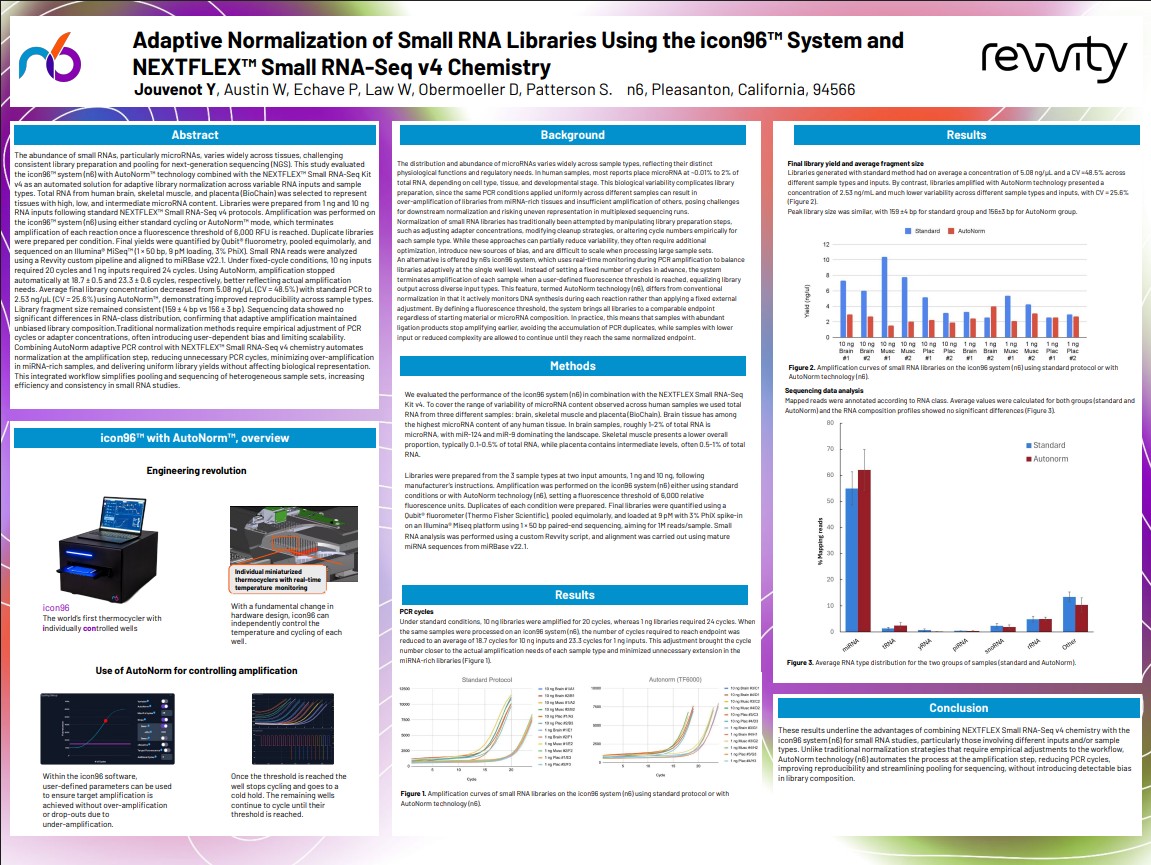
The abundance of small RNAs, particularly microRNAs, varies widely across tissues, challenging consistent library preparation and pooling for next-generation sequencing (NGS). This study evaluated the icon96™ system (n6) with AutoNorm™ technology combined with the NEXTFLEX™ Small RNA-Seq Kit v4 as an automated solution for adaptive library normalization across variable RNA inputs and sample types. Total RNA from human brain, skeletal muscle, and placenta (BioChain) was selected to represent tissues with high, low, and intermediate microRNA content. Libraries were prepared from 1 ng and 10 ng RNA inputs following standard NEXTFLEX™ Small RNA-Seq v4 protocols. Amplification was performed on the icon96™ system (n6) using either standard cycling or AutoNorm™ mode, which terminates amplification of each reaction once a fluorescence threshold of 6,000 RFU is reached. Duplicate libraries were prepared per condition. Final yields were quantified by Qubit® fluorometry, pooled equimolarly, and sequenced on an Illumina® MiSeq™ (1 × 50 bp, 9 pM loading, 3% PhiX). Small RNA reads were analyzed using a Revvity custom pipeline and aligned to miRBase v22.1. Under fixed-cycle conditions, 10 ng inputs required 20 cycles and 1 ng inputs required 24 cycles. Using AutoNorm, amplification stopped automatically at 18.7 ± 0.5 and 23.3 ± 0.6 cycles, respectively, better reflecting actual amplification needs. Average final library concentration decreased from 5.08 ng/µL (CV = 48.5%) with standard PCR to 2.53 ng/µL (CV = 25.6%) using AutoNorm™, demonstrating improved reproducibility across sample types. Library fragment size remained consistent (159 ± 4 bp vs 156 ± 3 bp). Sequencing data showed no significant differences in RNA-class distribution, confirming that adaptive amplification maintained unbiased library composition. Traditional normalization methods require empirical adjustment of PCR cycles or adapter concentrations, often introducing user-dependent bias and limiting scalability. Combining AutoNorm adaptive PCR control with NEXTFLEX™ Small RNA-Seq v4 chemistry automates normalization at the amplification step, reducing unnecessary PCR cycles, minimizing over-amplification in miRNA-rich samples, and delivering uniform library yields without affecting biological representation. This integrated workflow simplifies pooling and sequencing of heterogeneous sample sets, increasing efficiency and consistency in small RNA studies.