Check out the latest USDA publication using AutoNorm for full-length 16S sequencing
READ NOW


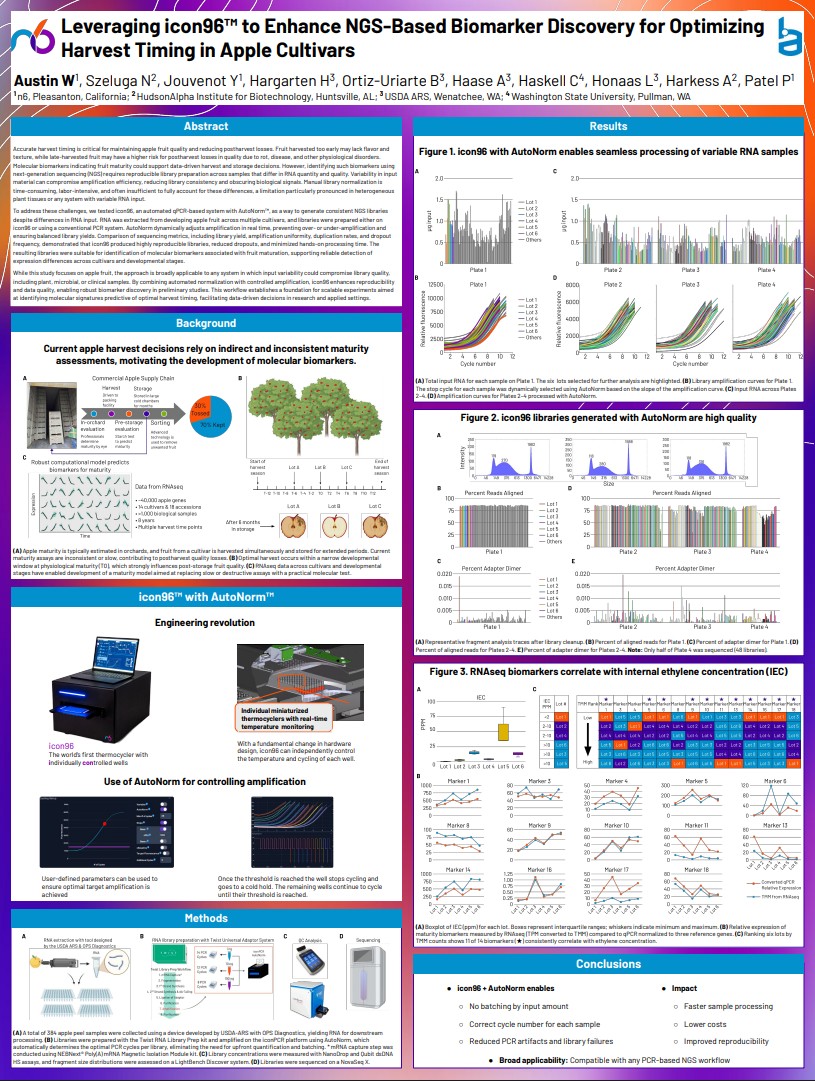
Accurate harvest timing is critical for maintaining apple fruit quality and reducing postharvest losses. Fruit harvested too early may lack flavor and texture, while late-harvested fruit may have a higher risk for postharvest losses in quality due to rot, disease, and other physiological disorders. Molecular biomarkers indicating fruit maturity could support data-driven harvest and storage decisions. However, identifying such biomarkers using next-generation sequencing (NGS) requires reproducible library preparation across samples that differ in RNA quantity and quality. Variability in input material can compromise amplification efficiency, reducing library consistency and obscuring biological signals. Manual library normalization is time-consuming, labor-intensive, and often insufficient to fully account for these differences, a limitation particularly pronounced in heterogeneous plant tissues or any system with variable RNA input. To address these challenges, we tested icon96, an automated qPCR-based system with AutoNorm™, as a way to generate consistent NGS libraries despite differences in RNA input. RNA was extracted from developing apple fruit across multiple cultivars, and libraries were prepared either on icon96 or using a conventional PCR system. AutoNorm dynamically adjusts amplification in real time, preventing over- or under-amplification and ensuring balanced library yields. Comparison of sequencing metrics, including library yield, amplification uniformity, duplication rates, and dropout frequency, demonstrated that icon96 produced highly reproducible libraries, reduced dropouts, and minimized hands-on processing time. The resulting libraries were suitable for identification of molecular biomarkers associated with fruit maturation, supporting reliable detection of expression differences across cultivars and developmental stages. While this study focuses on apple fruit, the approach is broadly applicable to any system in which input variability could compromise library quality, including plant, microbial, or clinical samples. By combining automated normalization with controlled amplification, icon96 enhances reproducibility and data quality, enabling robust biomarker discovery in preliminary studies. This workflow establishes a foundation for scalable experiments aimed at identifying molecular signatures predictive of optimal harvest timing, facilitating data-driven decisions in research and applied settings.