


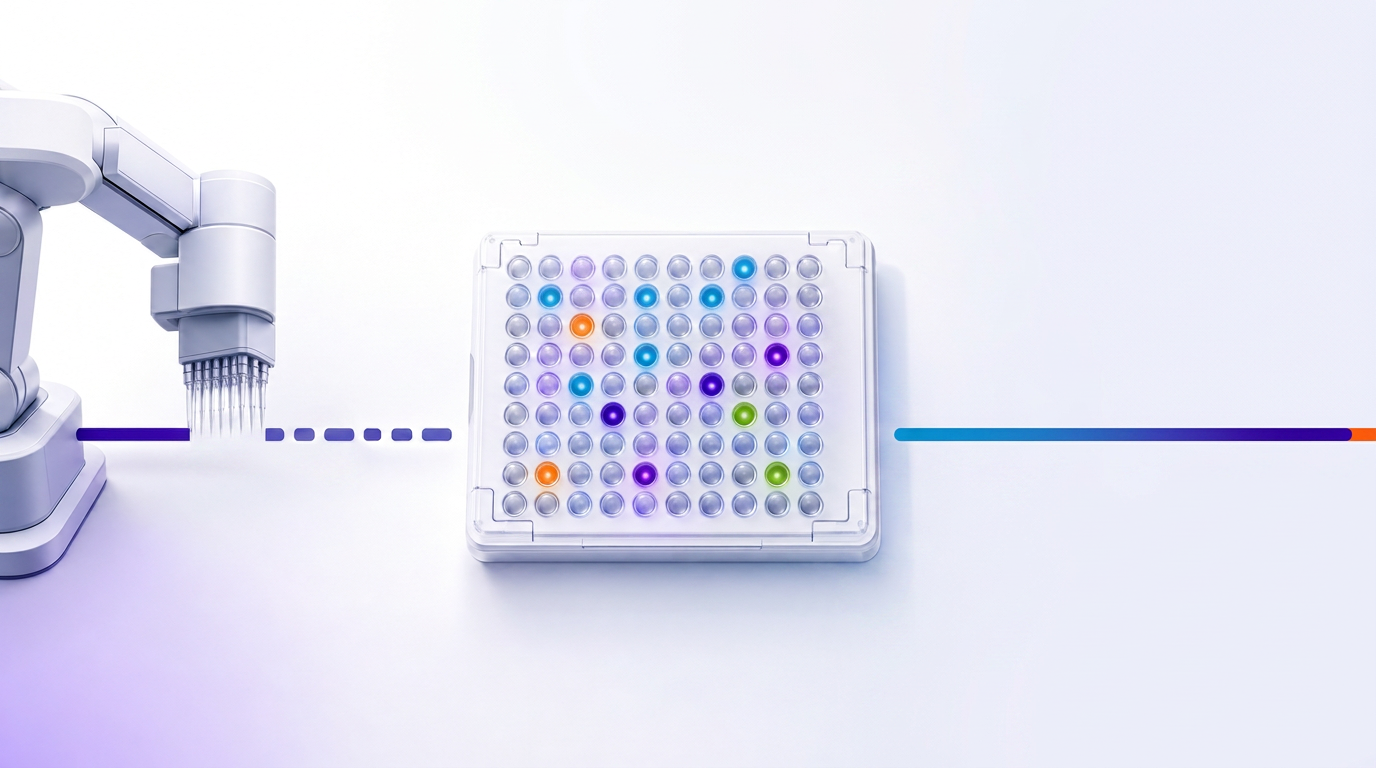
The robots are here. For PCR. And they’re impressive.
Beckman. Hamilton. Tecan. Revvity. Six-axis arms, barcode readers, plate hotels, scheduling software that coordinates a dozen instruments without a single human handoff. Modern NGS workcells are genuinely remarkable pieces of engineering — and they've transformed what high-throughput genomics labs can do at scale.
There's just one problem. Sitting at the center of every one of them is a thermocycler that hasn't fundamentally changed since the ‘80s. Fixed program. Uniform cycling. No feedback. No per-well adjustment. No idea what's happening inside each reaction.
The most sophisticated automation in your lab stops at the thermocycler door. Everything before it: automated. Everything after it: automated. The part where library quality is actually determined? Still a black box running a number someone picked from a protocol.
We’ve come a long way in PCR automation, but there’s a logical leap we need to make next. This post explores where we are and where we need to go to reach the next level of PCR automation — particularly as it pertains to NGS library preparation — to change our workflows, not incrementally, but fundamentally.
What problems is PCR automation trying to solve?
Before evaluating any automation approach, it helps to be precise about the objective. Most labs are chasing some combination of the following:
Scale without headcount. Processing hundreds to thousands of samples per week with fixed or shrinking teams requires removing manual steps from the critical path. Every pipetting step that a technician touches is a step that doesn't scale linearly.
Reproducibility across operators and shifts. Manual pipetting introduces variability. Different operators, different tips, different fatigue levels, different times of day — all of it adds noise to a workflow where noise compounds. Automation replaces that variability with machine precision.
Eliminating throughput bottlenecks. In most NGS workflows, the bottlenecks aren't the instruments — they're the manual interventions between them. Quantifying 96 libraries. Normalizing by hand. Flagging failed samples. Re-running dropouts. These are the steps that eat technician time and stretch turnaround.
Reducing the cost of failure. A failed library prep run on a 96-well plate isn't just a reagent cost — it's a delayed sequencing slot, a repeat extraction if material allows, additional technician hours, and potentially a missed clinical timeline. At scale, these failures compound (read up on the cost of NGS failure here).
Auditability and traceability. Regulated and high-throughput production labs need complete chain-of-custody documentation. Manual steps are documentation liabilities. Automated steps are logged, timestamped, and reproducible.
Learn more about the cost of NGS normalization (in time, reagents, and library quality) here.
What PCR automation platforms and approaches currently exist?
This is where the landscape gets complicated. "PCR automation" means different things to different vendors, and most of them are solving different pieces of the same problem.
Here's an overview of what's available, what each approach actually does, and where each one runs out of road.
Liquid handling robots
The backbone of modern automated NGS workflows. Platforms like the Beckman Coulter Biomek i-Series, Hamilton STAR and Vantage, Tecan Fluent, and Opentrons OT-2 and Flex handle pipetting with precision that no human can match at scale. They dispense reagents, reformat plates, manage tip inventory, and execute multi-step protocols without drift or fatigue.
What they genuinely solve: pre-PCR steps. Extraction plate reformatting, master mix preparation, adapter addition, size selection, bead handling. These steps involve pipetting, and liquid handlers are very good at pipetting.
What the robots can't touch: anything that happens after the plate goes into a thermocycler. They load the plate. They standby until it's done. . The cycling itself — the part where amplification quality is determined — is entirely outside their automated scope.
A liquid handler running a perfect protocol still delivers a plate of variably amplified libraries to the next step, because the thermocycler it's paired with has no way to respond to what's happening in each well.
Integrated workcell systems
The logical extension of liquid handling automation: integrate the liquid handler, thermocycler, plate hotel, and robotic transport arm into a single enclosed system. Platforms in this category include Hamilton's NGS workcell configurations, PerkinElmer sciclone implementations, Agilent Bravo-based systems, and custom integrations built around major liquid handling platforms.
These systems automate the physical movement of plates between instruments and eliminate the human-in-the-loop handoffs that create variability and delay. A plate moves from liquid handler to thermocycler to cooling station to liquid handler without anyone touching it.
The limitation is structural: the thermocycler inside the workcell is still a conventional thermocycler. The robotic arm is smart. The scheduling software is smart. The cycler is not. It receives a plate, executes a fixed program, and returns it. Workcells automate the logistics of PCR. They don't automate amplification.
The result: a highly sophisticated system that delivers variable, un-normalized libraries to a post-PCR liquid handler, which then has to run quantification, normalization, and pooling steps to correct for the variability the cycler introduced. The automation infrastructure is impressive. The workflow still has a passive, dumb machine at its center.
Purpose-built library prep systems
A different philosophy: instead of building automation around flexible, general-purpose instruments, build a dedicated system that performs library preparation from start to finish using a predefined workflow. Examples include the MGI MGISP-960, Element Elevate library prep, and Agilent Magnis for automated target-enrichment library prep.
These platforms deliver genuine end-to-end automation within their intended applications. The trade-off is flexibility. They're optimized for specific library prep chemistries, sample types, and protocols. Stay within the validated workflow, and they can dramatically reduce hands-on time and improve reproducibility. Step outside those boundaries — unusual sample inputs, custom chemistries, or novel library preparation methods — and customization becomes limited or impossible.
The PCR amplification step inside these systems also remains fundamentally conventional. While some platforms incorporate process monitoring and workflow QC, amplification is still performed using a fixed thermal cycling program applied uniformly across every well. The instrument automates the workflow surrounding PCR, but it does not adapt amplification to the behavior of individual samples in real time.
LIMS and software orchestration
Laboratory information management systems (LIMS) and workflow orchestration software — LabVantage, STARLIMS, Benchling, and custom implementations — provide the connective tissue for automated labs: sample tracking, protocol versioning, failure flagging, rerun triggering, pooling calculations, and sequencing submission.
These systems are essential at scale and do a genuine job of managing complexity. But they're information managers, not problem solvers. A LIMS can flag a sample that failed library prep, track it for rerun, and document the failure in an audit trail. It cannot prevent the failure. It cannot go back in time and give that well two more cycles.
LIMS sophistication is often inversely proportional to how well the upstream instruments are performing. The more failures you're tracking, the better your LIMS needs to be. The fewer failures you have, the less you need it to manage.
The comparison

The pattern is clear. Every category of PCR automation addresses the logistics, the pipetting, the tracking, or the physical movement of samples. Not one of them — until iconPCR —adaptively controls the amplification reaction itself.
Automating around the thermocycler leaves the hardest problems unsolved
Here's the uncomfortable truth about sophisticated NGS automation workcells: they're built around a passive machine.
The liquid handler sets the plate up perfectly. The robotic arm moves and places it with precision. The scheduling software coordinates every instrument beautifully. And the plate goes into a conventional thermocycler that runs the same fixed program on every well — regardless of input concentration, regardless of amplification efficiency, regardless of what's actually happening in each reaction.
The variability that creates most library prep failures isn't in the pipetting — it’s in the samples — different input quantities, different quality scores, different fragmentation profiles — and in the amplification response to that variability. Perfect pipetting steps delivering variable inputs to a fixed-cycle thermocycler still produce variable libraries.
Those variable libraries come back to the liquid handler for post-PCR processing. Quantification. Normalization. Manual pooling calculations. Steps that exist entirely to correct for the uneven amplification that just happened. This is not a minor inconvenience — it is a significant portion of the total workflow time, a major source of pipetting error in the final pool, and a set of steps that scales linearly with sample count.
And when samples fail — when low-input wells don't amplify to usable yield under the fixed cycle number — the LIMS flags them, the technician is notified, and the rerun process begins. Highly automated workflows still require human intervention to manage the failures that the thermocycler created and couldn't prevent.
And the only thing worse than problems you know about and address manually is the ones that don’t show up until after sequencing. Automated QC flags undercycling issues, but it generally misses problems caused by overcycling. In all likelihood, some of your samples will have amplified past the plateau phase. That means duplicates, chimeras, and an overall inaccurate representation of the original sample biology. (Read more about how PCR impacts data quality here)
You've automated the assembly line, but the most critical machine on the floor is still subject to manually set conditions.
How do we actually automate PCR amplification itself?
With a smart thermocycler. iconPCR™ with AutoNorm technology addresses the automation gap at the instrument level — not by adding more robots around the thermocycler, but by making the thermocycler itself intelligent.
What changes inside the reaction:
Every well in an icon96 instrument is monitored individually in real time. AutoNorm technology monitors fluorescence cycle by cycle in each reaction independently. When a well reaches the defined amplification threshold — indicating the reaction has reached its optimal amplification endpoint — that well stops cycling. Adjacent wells with lower starting input continue. High-input wells stop early. Low-input wells get the cycles they need. The plate converges on a normalized output not because every sample started in the same place, but because the instrument responded to each one individually.
The result: libraries come off the instrument already normalized. The post-PCR quantification and normalization workflow that currently requires a return trip to the liquid handler — Qubit, qPCR quant, SPRI normalization, manual dilution, pooling calculation — collapses into a single cleanup step.
See a manual library prep workflow comparison here.
What changes at the integration layer:
iconPCR isn't a standalone instrument that breaks an automated workflow. It's designed to sit inside one.
- Universal liquid handling robot compatibility: Works seamlessly with Beckman, Hamilton, Tecan, Opentrons, and other major liquid handling platforms.
- Fully skirted plate accommodation: Standard 96-well format fits directly into your current automation setup without modifications.
- Streamlined API integration: Comprehensive software API enables autonomous operation within private networks, with endpoints for device control, protocol management, and real-time experiment monitoring.
- RESTful API architecture: JSON Web Token authentication, rate limiting, and standardized HTTP endpoints ensure secure, reliable integration with existing LIMS and workflow orchestration systems.
- Real-time status monitoring: Track device state, drawer position, and experiment progress through dedicated API endpoints for seamless workflow coordination.
What changes at the outcome layer:
The workflow numbers tell the efficiency story directly. Per 96-sample batch, iconPCR delivers:
- 24 fewer manual touch points by eliminating QC and normalization steps, not automating around them
- >3 hours reduction in hands-on time, freeing technician time from repetitive quantification and normalization
- 60% reduction in total workflow time from sample to sequencing-ready libraries
- 40–60% reduction in consumable costs through optimized cycling and simplified workflows
- 96% fewer pipette tips and reagent tubes per batch compared to standard workflows
- Fewer reruns with AutoNorm rescuing marginal samples that would fail under fixed cycling and reducing the failure rate that drives rerun costs

Figure 1: Eliminated plastics and reagents per 96-well run
What does a fully automated PCR workflow look like with iconPCR?
Sample in: Automated extraction delivers normalized or variable-input plates to the liquid handler. Master mix preparation, adapter ligation, and size selection proceed on the liquid handler per standard protocol — no changes to pre-PCR automation required.
Amplification: The plate is transferred to iconPCR — manually or via robotic arm in a fully integrated workcell. AutoNorm runs. Each well is monitored in real time. Wells stop at their individual thresholds. Run status is streamed to LIMS via API. The instrument signals completion.
Libraries out: The normalized plate is returned to the liquid handler for a single cleanup step. No Qubit. No qPCR quant. No SPRI normalization. No manual dilution math. Direct pooling. LIMS receives per-well endpoint data and closes the experiment record.
Contrast with the conventional automated workflow: The same process on a standard workcell includes: post-PCR quant (liquid handler + plate reader), result review and normalization calculation (technician or LIMS), SPRI normalization (liquid handler), re-quant to confirm normalization accuracy, and manual pooling. Marginal samples flagged for rerun trigger a separate queue. Total additional steps: 5–7. Total additional hands-on time: >3 hours per plate.
iconPCR doesn't add intelligence to the workflow around the thermocycler. It puts it inside one. Further explore how iconPCR fits into automated workflows
FAQ
What is PCR automation and why does it matter for NGS labs?
PCR automation refers to the use of robotic systems, integrated workcells, and software platforms to reduce manual steps in PCR-based workflows. In NGS library preparation, automation matters because manual pipetting introduces variability, limits throughput, and creates bottlenecks at quantification and normalization steps. Most PCR automation focuses on what happens before and after amplification — the thermocycler itself has historically remained a fixed, non-adaptive instrument.
What types of automation platforms are used in PCR workflows?
The main categories are: liquid handling robots (Beckman, Hamilton, Tecan, Opentrons) for pipetting automation; integrated workcells that combine liquid handlers, thermocyclers, and robotic transport arms into closed systems; all-in-one library prep platforms optimized for specific workflows; and LIMS and software orchestration tools for sample tracking and workflow management. Each category automates different parts of the workflow — none of them, until recently, automated the amplification reaction itself.
Can liquid handling robots automate PCR amplification?
No. Liquid handling robots automate pipetting steps before and after PCR — reagent preparation, plate reformatting, post-amplification normalization. They load plates into thermocyclers and retrieve them after cycling, but they have no ability to influence what happens inside the reaction. The thermocycler determines amplification quality; the liquid handler manages everything around it.
What are the limitations of current PCR automation systems?
The central limitation is that all current automation approaches treat the thermocycler as a passive endpoint. They automate the logistics of PCR without automating amplification itself. The result: variable library yields still require post-amplification quantification and normalization; sample dropout still triggers manual intervention and reruns; and the fixed-cycle thermocycler remains the primary source of library quality variation in an otherwise automated workflow.
How does automated library normalization work?
In conventional workflows, library normalization after PCR involves quantifying each library (by fluorometry, qPCR, or capillary electrophoresis), calculating molar concentration, and diluting or pooling to a target molarity. This is automatable with a liquid handler but still requires the quantification step to precede it. AutoNorm normalizes libraries during amplification — each well stops at a defined fluorescence threshold — so post-amplification normalization is eliminated rather than automated.
What liquid handling platforms are compatible with iconPCR?
iconPCR is compatible with major liquid handling platforms including Beckman Coulter Biomek, Hamilton STAR and Vantage, Tecan Fluent, and Opentrons OT-2 and Flex, as well as other major liquid handling systems. Standard fully skirted 96-well plate format means iconPCR fits directly into existing automation setups without deck modifications.
How does iconPCR integrate with LIMS and lab automation software?
iconPCR provides a RESTful API with JSON Web Token authentication, rate limiting, and standardized HTTP endpoints. This enables device control, protocol management, and real-time experiment monitoring — making iconPCR a controllable, observable node in an automated workflow network rather than a passive instrument. API endpoints support integration with existing LIMS platforms and workflow orchestration systems, with per-well run data available for automated logging and downstream analysis.
What is the difference between automated PCR and smart PCR?
Automated PCR typically refers to robotic systems that handle plate setup, loading, and retrieval around a conventional thermocycler — automating the logistics of PCR without changing how amplification is controlled. Smart PCR refers to instruments that monitor and actively respond to amplification in real time, adjusting cycling on a per-well basis based on actual reaction progress. iconPCR's AutoNorm technology is an example of smart PCR: it doesn't just run a fixed program; it determines when each individual well is done, and it’s the only system that does so on a per-well basis.
How much time can automated NGS library prep save per run?
With iconPCR and AutoNorm, labs report greater than 3 hours reduction in hands-on time per 96-sample batch, a 60% reduction in total workflow time from sample to sequencing-ready libraries, and elimination of 24 manual touch points per plate. These gains come primarily from eliminating post-amplification quantification and normalization steps that are required in conventional workflows — automated or not — to correct for variable PCR output.
*For Research Use Only. Not for use in diagnostic procedures. iconPCR™ products are intended for laboratory research applications only and have not been validated for clinical diagnostic use.


