


.png)
Thirty-three years ago, Kary Mullis won a Nobel Prize for an idea that could be summarized in three words: heat, cool, repeat.
PCR changed everything. Suddenly, we could amplify DNA to the point that we could see it. Measure it. And then manipulate it. And the instrument that made PCR possible, the humble thermocycler, was a triumph of engineering for its time.
The name of the game was volume: Amplify. Amplify. Amplify. The OG thermocycler did it well. But it did it blind.
Enter qPCR – amplification in real-time. Amplification we could see. Measure while you amplify. Commercial real-time PCR instruments entered the scene roughly 10 years later….and that’s where we’ve been ever since.
Embarrassing? A little. But hey, engineering is hard. And it takes a lot of creativity to imagine where we could go next. A lot of creativity and a refusal to accept the issues that qPCR still can’t solve, especially those that are critical problems for preparing sequencing libraries – arguably one of the most impactful applications of PCR to date:
- Overamplification (AKA introducing artifacts and chimeras)
- Undercycling (AKA sample dropout)
- Normalization (so you can get a similar yield from variable samples)
- and Guesswork (because at the end of the day, you’re still guessing on cycle number)
It’s time for a new era of PCR. Time to go beyond just seeing amplification to controlling it. Intelligently. On an individual well level. We call it the icon era. And we think you will too once you get to know it…..
Era 1: Ignorance is bliss
How did the first PCR thermal cycler work — and what were its limits?
The original thermocycler did one thing: move temperature through a programmed sequence. Denature, anneal, extend. Repeat. Every well on the block received the same treatment, at the same time, for the same number of cycles.
The limitation was baked in from day one: the machine had no idea what was happening inside the tube. It couldn't tell if your amplification was efficient or sluggish, whether one sample had 10x more template than the next, or whether you'd hit diminishing returns 8 cycles ago. It cycled until you told it to stop. That was the deal.
For basic PCR and simple cloning workflows, this was fine. You optimized once, locked in your conditions, and moved on.
For NGS library prep — where input quantity varies, sample quality is inconsistent, and PCR artifacts compound directly into sequencing noise — it's a foundational problem.
Era 2: Observe the trainwreck
How did qPCR machines change the game?
The qPCR thermocycler was a genuine paradigm shift because it added something the original PCR thermal cycler never had: vision.
Real-time fluorescence detection let researchers watch the reaction unfold cycle by cycle. You could see the exponential phase. You could quantify starting template. You could catch efficiency problems before they became garbage data. qPCR machines turned the black box into a window.
This was transformative. It launched an entire category of diagnostics, gene expression analysis, and copy number quantification. The qPCR thermocycler became the workhorse of molecular biology.
But here's what it still couldn't do: act on what it saw.
The machine watched. It measured. It reported. And then you — the scientist — had to interpret the data, adjust your next experiment, and run it again. The reaction itself couldn't change course in real time. Every well still received the same cycling program from start to finish.
qPCR instruments have eyes. They don’t have brains.
Why do overcycling and undercycling remain unsolved problems? Why haven't workarounds fixed them?
If qPCR machines could see the problem, why hasn't it been solved?
Because seeing isn't intervening. With qPCR, issues became apparent, but only after precious samples (not to mention time) were already wasted. It gave us the power to do better…next time.
Overcycling is the most familiar villain in NGS workflows. Too many cycles means exponential accumulation of PCR duplicates, chimeric reads, index-hopping artifacts, and a sequencing run increasingly populated by amplification noise rather than real biology.
Undercycling is less discussed but equally damaging. Low-input or degraded samples that don't get enough cycles produce libraries too shallow to be useful — wasted prep time, wasted reagents, failed samples that get manually flagged and re-run (if there’s any left to run).
The core problem: 96 wells, one program. Every well gets the same number of cycles regardless of what's actually happening.
Gradient thermocyclers were one attempt at a partial fix. By running a temperature gradient across the block, researchers could identify optimal annealing conditions for a given primer set. Useful for optimization experiments. Not useful for the actual problem — because gradient PCR test equipment addresses temperature optimization across space, not cycle optimization across samples. If your 96 samples have 96 different amplification efficiencies, a gradient block still can't help you. And they still have that same—you don’t know you’ve overcycled until it’s too late—problem.
The most common real-world workaround is more manual than most scientists like to admit: physically pulling wells off the thermocycler mid-run and putting them on ice to stop amplification at different cycle numbers. It works. It's also tedious, error-prone, throughput-killing, and not exactly the scalable precision genomics workflow anyone had in mind.
These aren't edge cases or sloppy technique. They're rational responses to a design constraint that has never been addressed at the instrument level. Until now.
Era 3: Relax and icon on
How does iconPCR™ represent a foundational shift in PCR instrumentation?
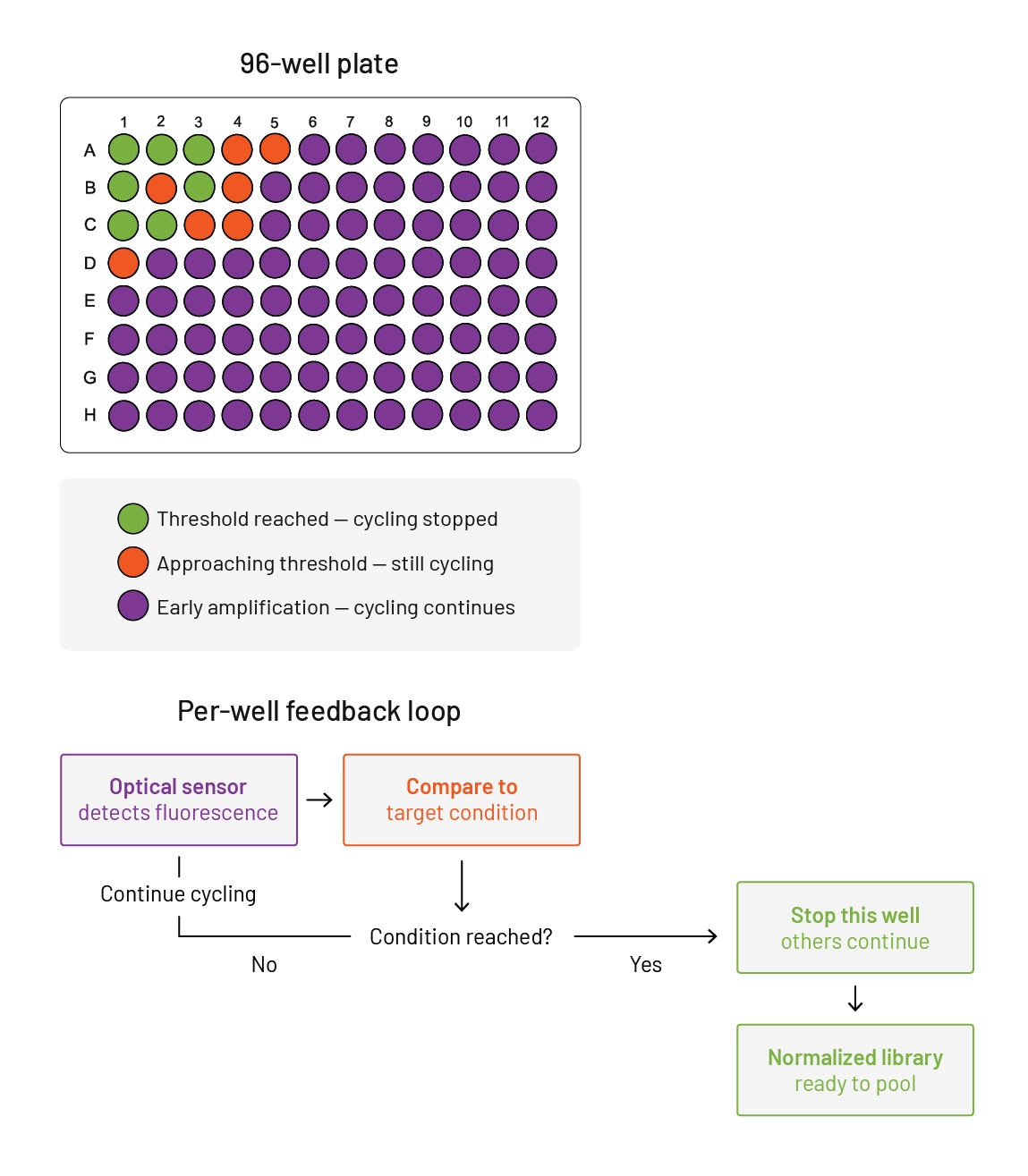
The icon96 and icon16 instruments don’t just monitor amplification. They control it — well-by-well, in real time.
Every well has its own optical sensor. The instrument tracks fluorescence cycle by cycle in each individual reaction. When a well reaches the target amplification threshold, it stops cycling — that well specifically, while adjacent wells continue if they need more cycles.
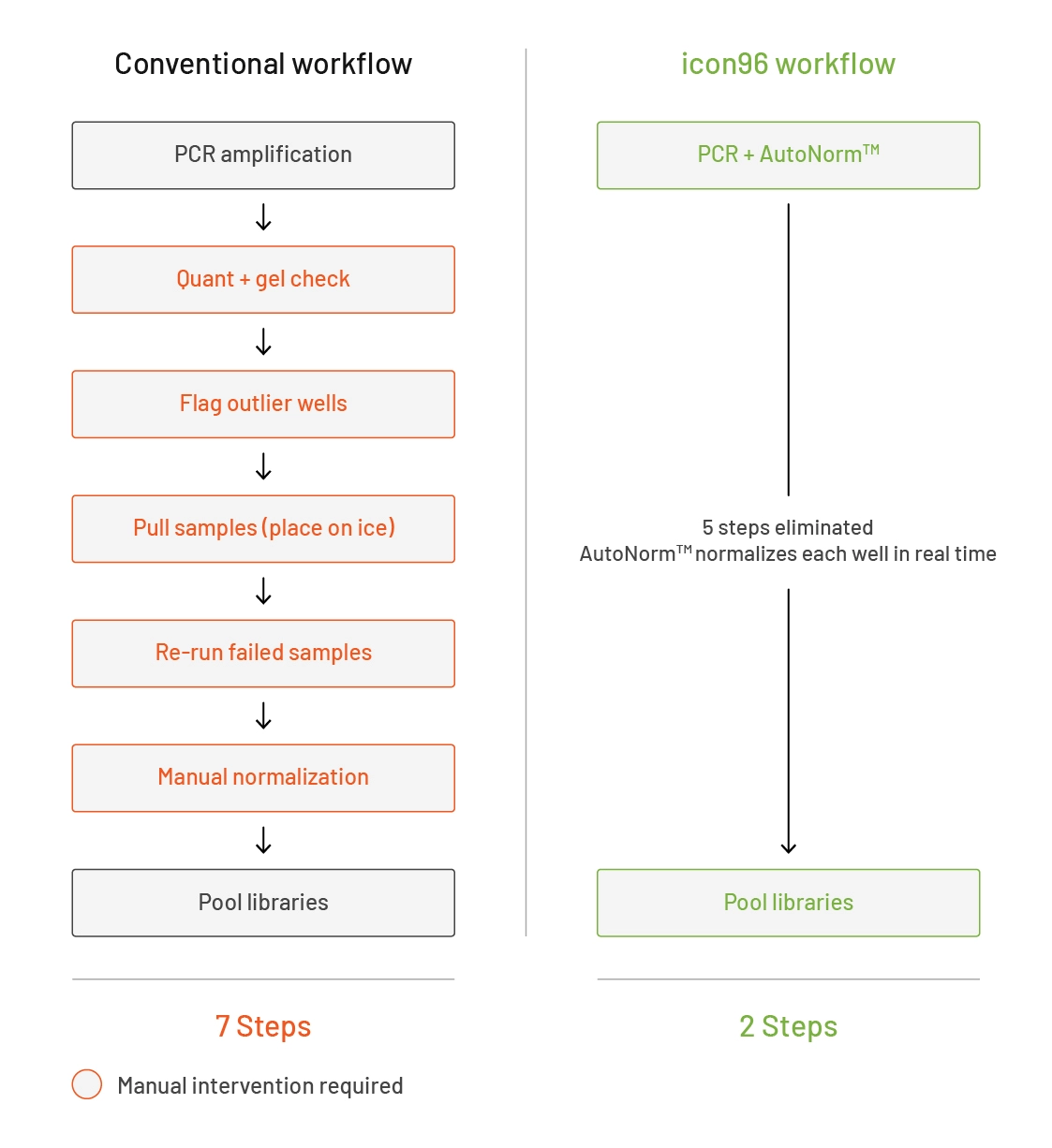
The result: normalized, sequencing-ready libraries in a single step, without manual quant, without individual SPRI normalization, without the whole normalization purgatory that sits between your PCR thermal cycler and your sequencer.
This is what AutoNorm™ technology does. It's not a software analysis layer. It's active, closed-loop control of the PCR reaction at the well level. The machine doesn't just see the reaction. It decides when the reaction is done.
96 wells. 96 individual reactions. Each one optimized on its own terms. No manual intervention. No pulling samples off the block. No compromises.
Here’s a (very simplified) schematic of how it works:
And in case you’re not convinced that we’re really talking about a foundational shift, here’s the impact on workflows:
So, yeah, we’re in our icon era. Now it’s time to sit back and watch how quickly the industry can adapt. We predict the shift will be faster and furiouser (yes, we made that word up) in applications where the impact is most critical….
Where each well really counts: high-stakes genomic applications
This isn't a quality-of-life upgrade for simple workflows. Individual per-well PCR control changes outcomes — especially in applications where the stakes are highest and the margin for cycling error is smallest.
Metagenomics (16S / shotgun)
Community composition analysis lives and dies on relative abundance accuracy. PCR chimeras — artifacts generated by incomplete extension products re-annealing across the template pool — are disproportionately generated in the plateau phase of amplification. Overcycling in 16S metagenomics doesn't just reduce data quality; it fabricates biological signal that doesn't exist, inflating some taxa and distorting diversity metrics. When every well is stopped at the optimal cycle, chimera generation drops, and the relative abundance data you're reporting actually reflects the community you sequenced.
Explore metagenomics data here.
Single-cell RNA sequencing
Single-cell workflows are defined by extreme input variation. Without extensive normalization, each well could vary dramatically in terms of total cell count and target RNA levels. A conventional thermocycler treats them all the same. The result: blown-out libraries from some wells and underamplified libraries from others.
Per-well control collapses that variance. Libraries from across the plate converge on usable depth, eliminating the need to normalize by cell count or RNA levels, reducing the number of failed cells, reducing the number of plates that need to be re-run, and improving the quality of the downstream cell clustering.
Explore RNA sequencing – including single cell - data here.
Low-input clinical sequencing: FFPE, liquid biopsy, cfDNA
This is another application where overcycling isn't just a data quality problem — it's a diagnostic one. FFPE-derived DNA is fragmented and chemically modified. cfDNA and ctDNA are present at vanishingly low concentrations. These samples are already at the edge of what library prep can reliably amplify. Overcycling drives duplicate rates up in already sparse libraries, burying true variants in noise. Undercycling loses samples that could have been rescued with a few more cycles.
Clinical labs are manually intervening — flagging failed or marginal libraries, re-running preparations — at real cost and real turnaround time. Per-well control rescues low-input samples that would otherwise fail while holding high-input wells back from the plateau. It's the difference between a reportable result and a repeat extraction.
Explore low input sequencing data here.
FAQ
What is a PCR thermal cycler and how does it work?
A PCR thermal cycler is an instrument that automates the temperature changes required for the polymerase chain reaction — cycling between high temperatures for denaturation, lower temperatures for primer annealing, and intermediate temperatures for extension. Traditional PCR thermal cyclers apply the same temperature program to all wells simultaneously, with no real-time feedback on what's happening inside individual reactions.
What's the difference between a PCR thermal cycler and a qPCR thermocycler?
A standard PCR thermal cycler runs the reaction and reports nothing — you find out what happened after the fact by running a gel or quantifying your product. A qPCR thermocycler adds real-time fluorescence detection, so you can monitor amplification as it happens and calculate starting template quantity. Both still apply the same cycling program to all wells. Neither can adjust cycling conditions on a per-well basis in real time.
How do qPCR machines improve on traditional PCR test equipment?
qPCR machines add optical detection to the standard thermocycler design, enabling real-time quantification of amplification. This made them transformative for diagnostics, gene expression, and copy number analysis. For NGS library prep, they allow researchers to monitor amplification efficiency — but the machine still can't act on that information to adjust individual wells mid-run.
What causes overcycling in PCR library preparation for NGS?
Overcycling occurs when a PCR reaction runs past the exponential amplification phase into the plateau. In the plateau phase, incomplete extension products accumulate and re-anneal to form chimeric molecules, duplicate rates spike, and the library increasingly reflects PCR artifacts rather than the original sample. The root cause in NGS workflows is that standard thermocyclers apply a fixed cycle number to all wells, which means the number is optimized for average input — leaving variable or low-input samples either over- or under-cycled.
How does icon96 differ from standard qPCR machines?
qPCR machines detect fluorescence in real time but don't change the cycling program based on what they detect. icon96 goes further: it uses per-well optical feedback to actively control amplification in each well individually, stopping each reaction at the optimal endpoint via AutoNorm technology. The result is normalized, sequencing-ready libraries without manual quant or normalization steps.
Can the icon96 replace both a PCR thermal cycler and a normalization step?
Yes. Because AutoNorm stops each well at a defined amplification threshold, libraries come off the instrument already normalized — no Qubit, no qPCR quant, no manual SPRI normalization. For NGS library prep workflows, it eliminates multiple steps between PCR amplification and final pooling.
What PCR test equipment is best for NGS library prep?
For any application where sample input varies, quality is inconsistent, or data accuracy is critical, individually-controlled PCR is the appropriate standard. icon96 is the only PCR instrument that provides individual well control with built-in normalization, making it purpose-built for the demands of modern NGS library preparation.


