


If you run drug discovery, you already know the DEL (DNA-encoded libraries) pitch: billions to trillions of small molecules, tagged with DNA, screened in a single tube. No plates. No robots pipetting one compound at a time. Just pooled chemistry and pooled sequencing doing the work that used to take a warehouse of automation.
It's one of the most elegant ideas in modern hit discovery. It's also quietly running on a 40-year-old piece of lab equipment that was never built for the job it's being asked to do.
Buried in the middle of every DEL workflow — after the selections, before the sequencer — is a PCR step. And PCR, as anyone running DEL campaigns already knows, doesn't treat every barcode fairly. Some amplify beautifully. Some barely amplify at all. The problem is, "barely amplified" and "wasn't really a hit" look identical by the time your enrichment data comes back.
This post is a primer on DEL, on where PCR sits inside it, and on why that one step deserves a lot more scrutiny than it usually gets.
What is a DNA-encoded library, exactly?
A DNA-encoded library (DEL) is a collection of small molecules, each permanently linked to a unique DNA barcode that records its synthetic history. Libraries are typically built through split-and-pool combinatorial chemistry: a set of chemical building blocks is reacted and tagged with a DNA sequence, the pool is split and reacted again with a new set of building blocks and a new tag, and the cycle repeats. A handful of synthetic cycles can generate a library of billions to trillions of unique compounds, each one identifiable later by reading its DNA tag (Peterson & Liu, 2023).
The screening logic is what makes DEL powerful. Instead of testing one compound per well, the entire pooled library is incubated with an immobilized drug target, unbound material is washed away, and whatever remains bound is presumed to contain your hits. Because the process is DNA-based, it scales in a way that traditional high-throughput screening (HTS) never could — and it's common to run many selection conditions on the same target in parallel: different protein constructs or mutants, apo versus ligand-bound states, off-target counter-screens, and successive rounds of increasingly stringent washing, often all at once (Peterson & Liu, 2023).
Where does PCR fit into a DEL workflow?
After selection, any DNA-tagged molecules that survived the wash are present in vanishingly small quantities; the literature describes recoverable material in the sub-attomole range. Before that DNA can be sequenced, it has to be amplified. The workflow, in short: select, wash, PCR-amplify the surviving barcodes, sequence by NGS, then computationally compare barcode abundance before and after selection to call which compounds were enriched — i.e., which ones are your hits (Peterson & Liu, 2023).
That PCR step is easy to treat as a formality. It isn't one. It's the hinge the entire experiment swings on.
Why is PCR such a problem for DEL specifically?
Every PCR reaction amplifies templates unevenly. That's true in any application. But DEL has a few characteristics that make ordinary PCR bias into something closer to a structural flaw:
The input is already at the edge of detectability. Post-selection barcode material is present in sub-attomole quantities — a tiny handful of molecules per well in many cases. At that scale, small differences in amplification efficiency between barcodes don't average out. They dominate the result.
The readout is the abundance. DEL doesn't measure activity directly — it infers binding from how enriched a barcode is after selection compared to before. If PCR doesn't amplify every barcode proportionally to its true starting abundance, the enrichment signal itself is corrupted, not just noisy.
You usually can't just re-run the selection. Unlike re-extracting a degraded DNA sample, you can't easily go back and re-select against the same target condition to get more material. Whatever came off that selection is what you have to work with at the PCR step.
Parallel conditions guarantee unequal starting material. Running five selection conditions on one target — mutants, apo/holo states, off-target controls, multiple rounds — means five wells with five different amounts of recoverable DNA, all typically run under one fixed thermocycler program.
The field has already named this problem directly. As Momentum Biotechnologies puts it: "PCR does not amplify all products equally, limiting the quantitative capacity of DEL screens." And critically: PCR is "susceptible to stochastic dropout of low-abundance species, particularly in early rounds of amplification." Their conclusion is worth sitting with: in a DEL screen, "it is therefore impossible to distinguish a non-binding ligand from a ligand that binds but is not faithfully amplified."
Read that last sentence again. It means a fixed-cycle thermocycler can manufacture false negatives that are statistically indistinguishable from real ones — and there's no way to tell, after the fact, which is which.
Overcycling and undercycling: two ways to lose the same experiment
The same exponential-amplification math that makes PCR powerful also makes it dangerous at both ends of the cycle count.
Undercycle a low-abundance barcode, and it never reaches detectable levels. It reads as absent. If that barcode represented a true low-affinity or slow-off-rate binder — often exactly the molecules worth chasing in early discovery — it's gone before sequencing ever sees it.
Overcycle a plate to rescue those low-abundance wells, and the high-abundance barcodes on the same plate blow past the exponential phase into plateau — where PCR duplicates, chimeric products, and GC-driven bias accumulate. Now the abundant barcodes look artificially more enriched than they really are, skewing the enrichment ranking that determines which hits are pursued.
There is no fixed cycle number that avoids both failure modes on a plate that contains both high- and low-abundance selection conditions simultaneously — which, in a typical multi-condition DEL campaign, is every plate.
What would fixing this actually require?
Structurally, the fix has to happen at the amplification step itself, not downstream in the bioinformatics stage. Deduplication and chimera-filtering pipelines can clean up some of the damage after sequencing, but they can't recover a barcode that dropped out of detection during PCR, and they can't undo enrichment-ratio distortion that happened before sequencing ever started.
What the problem actually calls for is amplification that responds to each well's own starting material in real time — stopping low-abundance wells once they've genuinely reached a usable signal, and stopping high-abundance wells before they drift into plateau-phase artifacts, all without a human presetting one cycle number for the whole plate in advance.
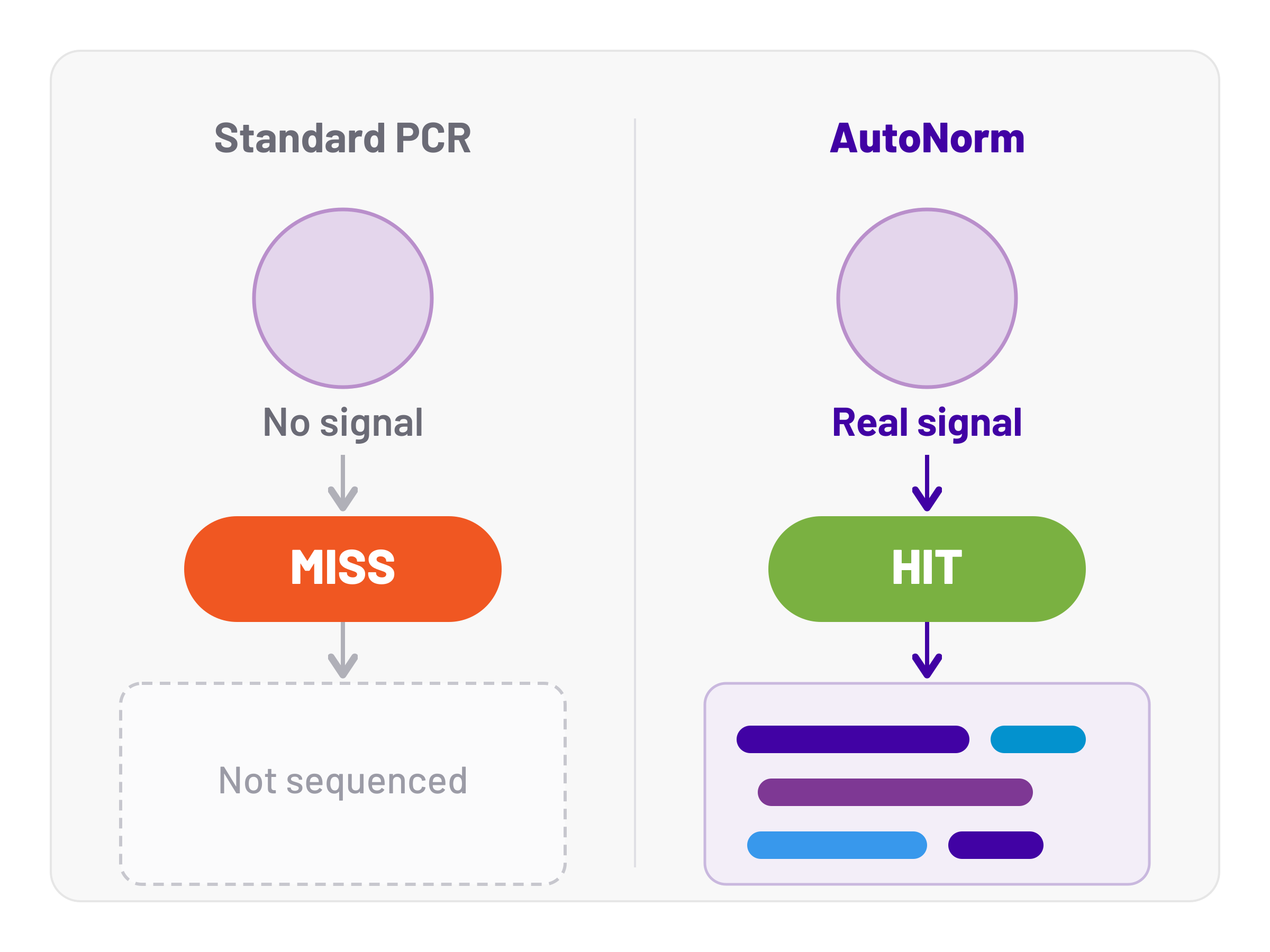
That's a fundamentally different way of running PCR than the field has had access to — and it's the exact mechanism n6 built iconPCR™ with AutoNorm to provide. iconPCR gives every well on a plate independent temperature control and real-time fluorescence monitoring, so each well can be stopped individually the moment it reaches its own optimal endpoint — instead of every well on the plate sharing one fixed cycle count regardless of how much material it started with (n6 Products). On icon96™, that's 96 independently monitored wells per plate — enough to run a full set of parallel DEL selection conditions side by side, with each one amplified on its own terms rather than forced through someone's best guess at a single cycle number.
This isn't purely theoretical for us. We're already helping pharma partners AutoNormalize their DEL sequencing libraries on iconPCR, and early results reinforce the fit between the two. It's hard to look at a documented, named failure mode like DEL's PCR dropout problem and not see a direct match for a thermocycler platform built specifically to stop treating every well the same way.
The takeaway
DEL is a genuinely powerful screening paradigm, and PCR is the step quietly determining how much of that power you actually get to keep. A hit that doesn't survive amplification isn't a failed compound — it's a failed cycle count. Until the amplification step can respond to what's actually happening in each well, some of the best molecules in your library may never make it far enough to be called a hit at all.
DEL isn't the only pooled, PCR-amplified selection method with this vulnerability — the same dynamic shows up in RNA display and other DNA/RNA-tagged affinity selection workflows, which we'll dig into separately.
If you're running DEL selections and want to talk through where adaptive, per-well amplification could fit into your workflow, reach out to n6 — we'd love to compare notes.
FAQ
What is a DNA-encoded library (DEL)?
A DNA-encoded library is a collection of small molecules, each covalently tagged with a unique DNA barcode that records how it was synthesized. Barcodes allow millions to trillions of compounds to be pooled, screened together against a drug target, and later identified by sequencing rather than by testing one compound per well.
How does DEL screening work?
A pooled DEL is incubated with an immobilized target, unbound material is washed away, and the DNA barcodes on any surviving bound molecules are PCR-amplified and sequenced. Barcode abundance before and after selection is compared computationally to identify which compounds were enriched — i.e., which are likely hits (Peterson & Liu, 2023).
Why is PCR a problem in DEL screening?
PCR doesn't amplify every DNA barcode with equal efficiency, and low-abundance barcodes are especially prone to stochastic dropout, particularly during early amplification cycles. Because DEL infers binding from barcode abundance, this bias can make a true binder appear to be a non-binder, with no reliable way to tell the two apart after the fact (Momentum Biotechnologies).
Can bioinformatics fix PCR bias in DEL data after sequencing?
Only partially. Deduplication and chimera-filtering tools can clean up some artifacts post-sequencing, but they can't recover a barcode that dropped below detection during PCR, and they can't undo distortion in enrichment ratios that occurred before sequencing began. The bias has to be addressed at the amplification step itself.
What's the difference between overcycling and undercycling in a DEL PCR step?
Undercycling leaves low-abundance barcodes below detectable levels, causing true hits to be missed. Overcycling pushes high-abundance barcodes into the plateau phase of amplification, generating duplicates and chimeric artifacts that inflate apparent enrichment. A single fixed cycle number applied across a plate with both high- and low-abundance wells can't avoid both problems simultaneously.
What is adaptive or per-well PCR amplification?
Adaptive, per-well PCR amplification monitors fluorescence in each individual reaction well in real time and stops cycling for that specific well once it reaches a defined amplification endpoint — rather than running every well on a plate through the same fixed cycle count. iconPCR with AutoNorm is built on this principle for NGS library preparation, giving each of 96 wells independent thermal control and real-time endpoint detection (n6 Products).
Does DEL PCR amplification bias affect hit-calling accuracy?
Yes. Because DEL hit-calling is based on comparing barcode enrichment before and after selection, any systematic amplification bias introduced during PCR directly affects which compounds are ranked as enriched, independent of their true binding behavior.
For Research Use Only. Not for use in diagnostic procedures. iconPCR products are intended for laboratory research applications only and have not been validated for clinical diagnostic use.


