Check out the latest USDA publication using AutoNorm for full-length 16S sequencing
READ NOW


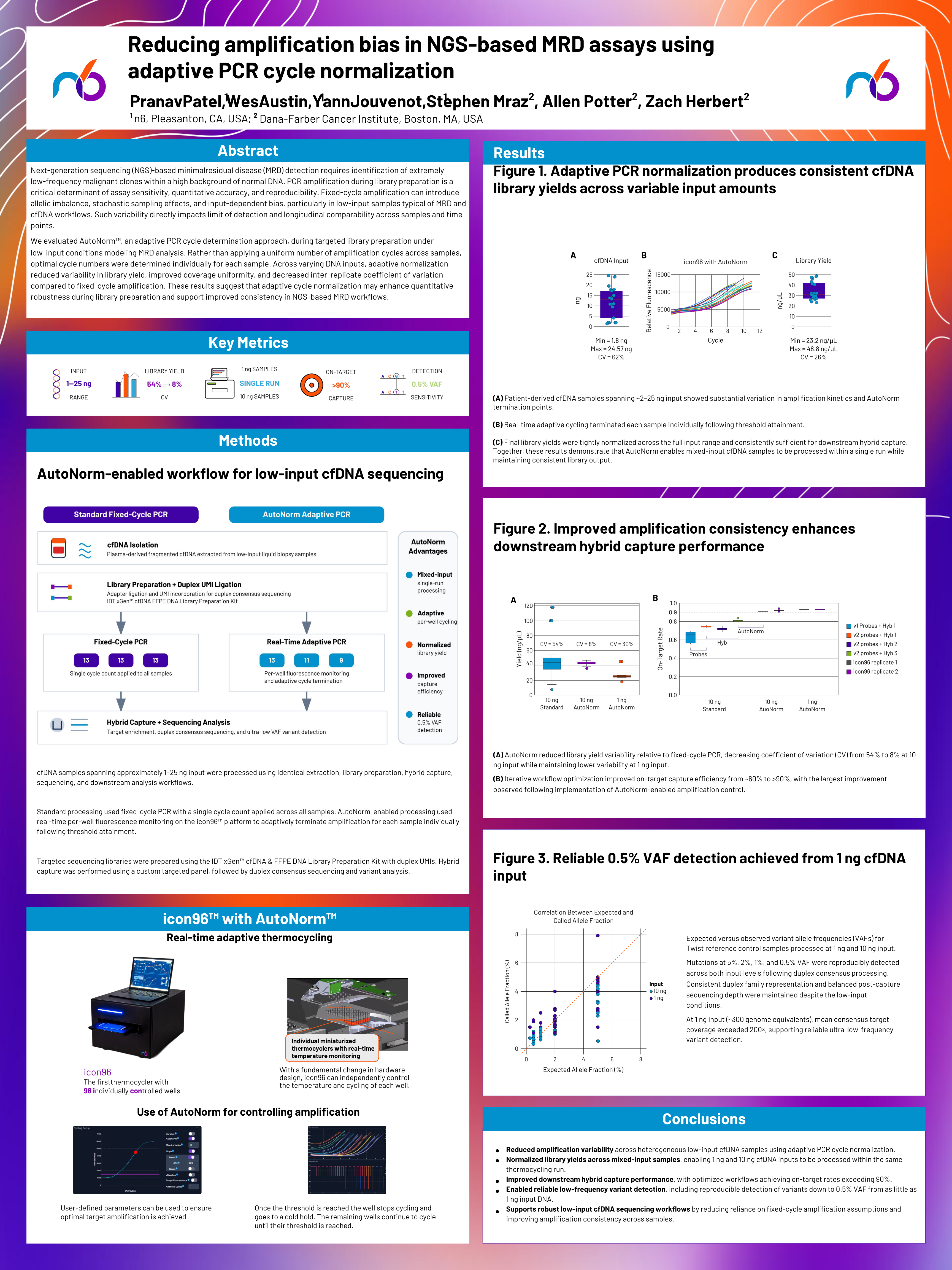
Next-generation sequencing (NGS)-based minimal residual disease (MRD) detection requires identification of extremely low-frequency malignant clones within a high background of normal DNA. PCR amplification during library preparation is a critical determinant of assay sensitivity, quantitative accuracy, and reproducibility. Fixed-cycle amplification can introduce allelic imbalance, stochastic sampling effects, and input-dependent bias, particularly in low-input samples typical of MRD and cfDNA workflows. Such variability directly impacts limit of detection and longitudinal comparability across samples and time points.
We evaluated AutoNorm™, an adaptive PCR cycle determination approach, during targeted library preparation under low-input conditions modeling MRD analysis. Rather than applying a uniform number of amplification cycles across samples, optimal cycle numbers were determined individually for each sample. Across varying DNA inputs, adaptive normalization reduced variability in library yield, improved coverage uniformity, and decreased inter-replicate coefficient of variation compared to fixed-cycle amplification. These results suggest that adaptive cycle normalization may enhance quantitative robustness during library preparation and support improved consistency in NGS-based MRD workflows.