


Next-generation sequencing (NGS) has become faster, cheaper, and more accessible — but one step stubbornly remains a workflow killer: NGS library quantification. For years, scientists have accepted this step as a necessary evil, but with rising sample throughput and increasingly variable inputs, quantification has become a true bottleneck in modern sequencing labs.
Today, a new approach is emerging — one that doesn’t automate quantification, but eliminates it altogether.
In a recent discussion with Yann Jouvenot, Director of Product at n6 Tec, we dug into why NGS library quantification slows labs down, where current tools fall short, and how iconPCR with AutoNorm™ is changing the game by producing perfectly normalized libraries directly from PCR.
Why NGS Library Quantification Exists — and Why It Hurts Throughput
Before sequencing, every library must be accurately quantified to ensure balanced loading of the sequencing flow cell. This is especially critical when multiplexing dozens — or even hundreds — of samples on a single flow cell.
“Library quantification is the Achilles’ heel of NGS prep — it’s time-consuming, error-prone, and surprisingly easy to get wrong.”
Traditional quantification tools include:
- Qubit or spectrophotometers for total amount of DNA in your library
- TapeStation/Bioanalyzer for insert size and library quality
- qPCR for accurate detection of sequenceable material (dsDNA with adapters)
The problem? Even the fastest methods require scanning every sample, and qPCR requires multiple plates, replicates, and standards. In a 96-sample workflow, quantification alone can consume:
- 1–2 hours of hands-on time
- 4–6 qPCR plates
- Additional purification steps
- Entire “mini-sequencing runs” (for labs who normalize using read counts)
Multiply that across multiple batches per week, and the cost — both in time and labor — becomes enormous.
The Quantification Nightmare: Variable Inputs Make It Worse
For labs handling low-quality or unpredictable samples, quantification becomes even more painful. Common low input applications include:
- FFPE: DNA damage and fragmentation lead to inconsistent yields
- cfDNA: Variable input amounts and quality
- Single-cell: Ultra-low input, high dropout risk
- Metagenomic samples: Total DNA ≠ target DNA
If you don’t quantify and normalize samples with variable inputs, the results are messy and downright risky.
“You don’t just risk imbalance — you risk dropouts. If you’re loading 96 samples, you probably need 96 results, not 94 or 95.”
And some samples are just too precious to waste on quantification. Add that to the time/resource costs, and most labs opt to just increase cycle number and over-amplify to avoid under-represented libraries. But over-amplification introduces PCR errors, such as:
- Duplicates
- Chimeras
- Distorted representation
- Lower data quality
It’s a lose-lose situation: either under-amplify and lose samples or over-amplify and compromise sequencing fidelity.
Why Normalization “Solutions” Like Beads and Liquid Handlers Don’t Work
A common misconception is that automation solves library normalization. It doesn’t.
Normalization by beads and enzymatic-based normalization methods still rely on over-amplification to ensure libraries reach a minimum threshold before normalization.
Over-amplification = artifacts = compromised data.
Liquid handlers can move samples — but they can’t undo over-cycling. So, automation can shift where quantification happens—but it can’t eliminate the flawed assumptions behind it.
“If your workflow is based on an over-amplified sample, the damage is already done. Duplicates and artifacts are baked in.”
Introducing iconPCR: The First System That Makes NGS Quantification Optional
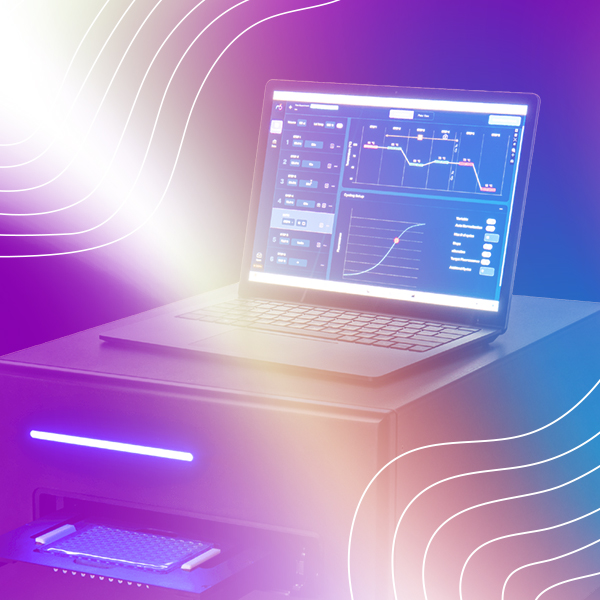
iconPCR changes the library prep paradigm. Instead of quantifying libraries after amplification, iconPCR quantifies, normalizes, and amplifies in the same step — at the single-well level. iconPCR runs on two fundamental technologies: Individual, well-by-well temperature control, and built-in AutoNorm intelligence.
AutoNorm uses real-time monitoring with dyes like SYBR Green to:
- Track amplification curves for every well
- Determine when each individual library has reached the ideal (predetermined) output
- Stops cycling per well at the exact right moment
No over-amplification. No dropouts. No manual decisions.
“With iconPCR and AutoNorm, you’re not quantifying after the fact — each well is monitored in real time, and the system decides when to stop cycling. That means perfectly normalized libraries, straight from PCR.”
This is not real-time PCR/qPCR/gradient PCR.
This is automated, well-level controlled amplification — a completely different category of technology.
Who Benefits Most From Eliminating NGS Library Quantification?
iconPCR shines in workflows where traditional quantification fails, including:
- Applications with variable inputs: cfDNA, FFPE, single-cell, metagenomics, environmental or clinical samples
- High-throughput sequencing centers: Any lab processing 96–384 samples at a time sees immediate, massive savings.
- Automation-first labs: iconPCR removes dozens of manual steps that robots can’t fix.
“Our users often say: ‘I can’t remember the last time I did a manual quantification.’”
How Much Time and Money Do Labs Save By Skipping Quantification?
Switching to iconPCR compresses 10+ hands-on steps into one.
Typical savings:
- 20–40% reduction in library prep time
- $7–$20 saved per sample in reagents alone
- Dramatically fewer failed libraries
- More reproducible sequencing runs
And because iconPCR prevents over-amplification:
- Fewer duplicates
- Fewer artifacts
- Better representation
- More balanced pools
Does replacing quantification by AutoNormalization affect data quality?
Yes—in a good way.
Traditional quantification requires over-cycling and post-hoc correction, but iconPCR eliminates the root cause of poor data quality: over-amplification.
Balanced outputs = naturally balanced sequencing.
“You don’t lose data quality by dropping traditional library preparation workflows — in fact, you gain consistency.”
A Future-Proof Platform for Any Sequencing Workflow
iconPCR works across:
- Any library prep kit
- Any assay
- Any sample type
“IconPCR is reagent-agnostic. It fits into any protocol — so your throughput and sample diversity can scale without changing your workflow.”
For labs trying to future-proof against growing sample volume or shifting sample types, eliminating NGS library quantification is one of the highest-impact upgrades available.
If You’re Searching for NGS Library Quantification Solutions, Read This
If you landed on this page after Googling NGS quantification or NGS library quantification, here’s the message from Yann:
“If you’re still doing manual normalization, you’re working too hard. Modern NGS shouldn’t require old-school pain.”
There is a better way.
And it doesn’t involve another quant kit, another robot, or another version of the same old workflow.
It involves removing the step entirely.
FAQ: NGS Library Quantification
Is this basically just qPCR?
No. It’s qPCR + automated control of cycle conditions at the single-well level. AutoNormalization is an intelligent module that uses qPCR to generate perfectly amplified libraries by stopping cycling once a predefined concentration is reached.
Will this work with my existing kits?
Yes. iconPCR is reagent-agnostic.
What about variable or low-input samples?
AutoNorm independently optimizes each well, avoiding both dropouts and over-cycling.
Does eliminating quantification affect sequencing quality?
Yes — by improving it. Switching from a standard workflow to AutoNormalization improves data quality (reduces chimeras, artifacts, and dropouts) while eliminating the need for quantification (upstream or downstream), so that more sample can be used for sequencing.


